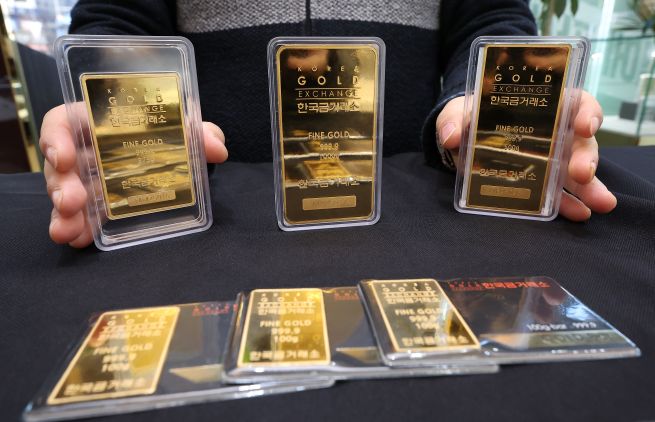
An employee organizes gold products at the Korea Gold Exchange in Jongno-gu, Seoul. (Yonhap)
SEOUL, Jan. 28 (Korea Bizwire) — South Korea’s central bank has slipped another place in the global rankings of official gold holdings, underscoring its long-standing reluctance to add bullion even as prices surge to record highs.
According to a report released Tuesday by the World Gold Council, the Bank of Korea held 104.4 metric tons of gold at the end of 2025, ranking 39th among the world’s central banks, down from 38th a year earlier. When institutions such as the International Monetary Fund and the European Central Bank are included, South Korea’s position falls to 41st.
Gold accounts for just 3.2 percent of the country’s foreign exchange reserves, placing it near the bottom globally — a sharp contrast to South Korea’s overall reserve stockpile of $430.7 billion, the world’s ninth largest as of late November.
The decline reflects more than a decade of inaction. After purchasing 40 tons in 2011, 30 tons in 2012 and 20 tons in 2013, the central bank has not added to its holdings since, keeping total reserves unchanged for 13 years. Over that period, South Korea’s ranking has steadily slipped as other countries accelerated their buying.
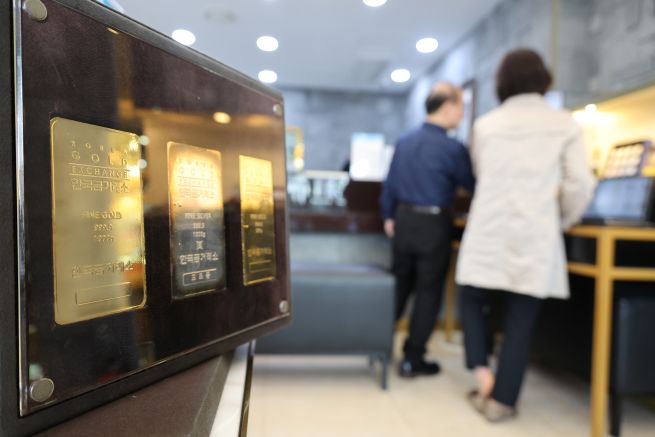
A display gold bar at the main branch of Korea Gold Exchange in Jongno, central Seoul. (Yonhap)
Several central banks have moved aggressively in recent years. Azerbaijan sharply increased its holdings over the past two years, while Poland emerged as the largest buyer in 2025, followed by Kazakhstan and Brazil.
The World Gold Council said that although the pace of purchases slowed slightly last year, central bank demand remained “relatively robust,” driven by heightened geopolitical and economic uncertainty.
That global appetite has helped propel gold prices to historic levels. Spot gold briefly climbed above $5,100 an ounce this week, extending a rally that saw prices jump 27 percent in 2024 and another 65 percent in 2025.
Despite the surge, the Bank of Korea has maintained a cautious stance, citing gold’s relatively low liquidity and high price volatility compared with assets such as government bonds.
Officials have also played down the strategic implications of other countries’ gold buying, attributing it largely to regional conflicts or efforts by some nations to reduce reliance on the U.S. dollar.

The headquarters of the Bank of Korea in Jung District, Seoul. (Image courtesy of Yonhap)
Some analysts say the central bank remains scarred by its experience in the early 2010s, when gold purchases were followed by a sharp price decline, reinforcing institutional reluctance to re-enter the market.
Globally, the United States remains the largest holder of gold, with more than 8,100 tons, followed by Germany, Italy, France and Russia. China ranked sixth, narrowing its gap with Russia after adding to its reserves last year.
As central banks around the world continue to view gold as a hedge against uncertainty, South Korea’s hands-off approach has increasingly stood out — not for what it holds, but for what it has chosen not to buy.
M. H. Lee (mhlee@koreabizwire.com)