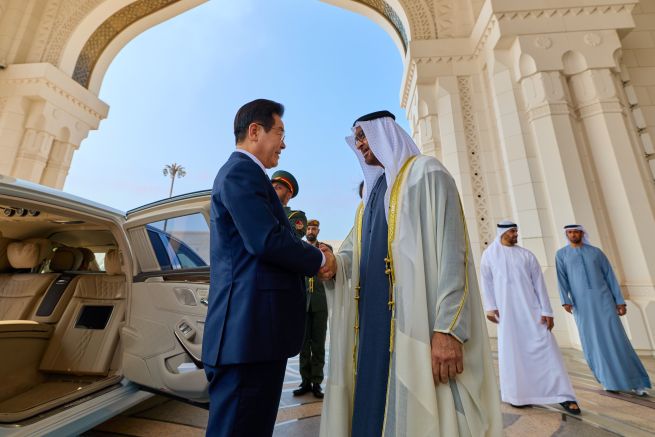
President Lee Jae-myung, on a state visit to the United Arab Emirates (UAE), greets President Mohammed bin Zayed Al Nahyan at the Abu Dhabi Presidential Palace on the 18th (local time). (Yonhap)
ABU DHABI & SEOUL, Nov. 19 (Korea Bizwire) — On a warm November morning in the Emirati capital, President Lee Jae-myung arrived at a polished conference hall filled with Korean and Emirati business executives, all seated beneath a chandelier of cascading glass. But it was the future — not the décor — that commanded the room.
Lee, making his first state visit to the United Arab Emirates, used the moment to lay out an unusually expansive vision. South Korea, he said, must reinvent its economic partnerships for an era defined by energy transition, shifting geopolitical alliances and the rise of artificial intelligence. The UAE, he suggested, would be at the center of that shift.
“We must secure momentum for shared growth,” Lee told the assembled CEOs, “by advancing cooperation in clean energy and the defense industry.”
It was a message aimed not only at his hosts but also at an anxious Korean public, watching as the country’s traditional growth engines — electronics, autos and shipbuilding — confront global competition and technological upheaval.
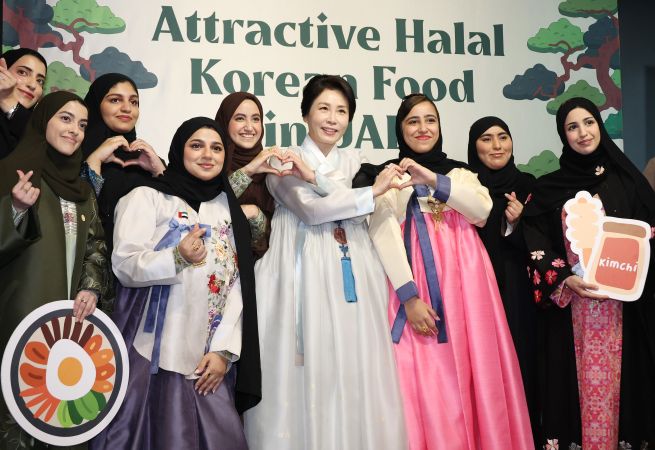
President Lee Jae-myung and First Lady Kim Hye-kyung, on a state visit to the United Arab Emirates (UAE), pose for a commemorative photo with participants during a halal K-food promotion event held at the Korean Cultural Center in Abu Dhabi on the 19th (local time). (Yonhap)
A Strategic Pivot to a Small but Ambitious Power
For Seoul, the UAE is no longer simply a buyer of nuclear reactors and weapons systems. Under Crown Prince Mohammed bin Zayed, the country has recast itself as a laboratory for post-oil economics — pouring billions into artificial intelligence, renewable energy and advanced defense systems. The Emirates wants to be a global AI hub by 2031; Korea wants to be its most reliable partner.
That mutual ambition has made the Middle Eastern nation an increasingly important node in Korea’s foreign policy. Nuclear energy cooperation began more than a decade ago with the Barakah reactor project; now, Lee wants to extend the partnership to nuclear fuel production and electricity systems.
In the renewable energy sphere, he sketched a vision in which the UAE’s enormous solar capacity could be linked with Korea’s advanced battery storage technologies — a pairing he said could help both nations meet their 2050 net-zero goals.
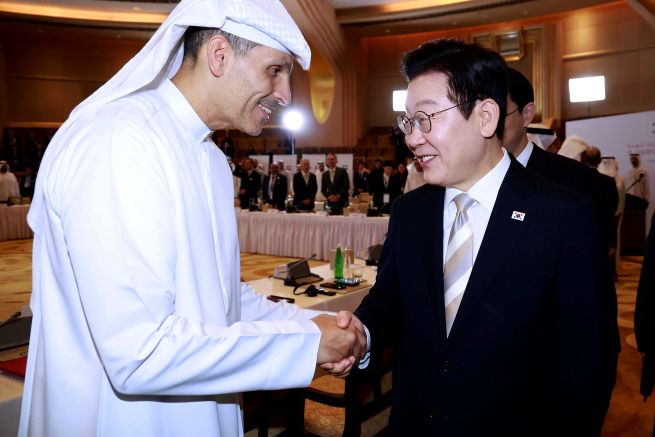
President Lee Jae Myung (R) shakes hands with Khaldoon Khalifa Al Mubarak, chairman of the Abu Dhabi Executive Affairs Authority, during a business roundtable in Abu Dhabi on Nov. 19, 2025, attended by business leaders of South Korea and the United Arab Emirates. (Yonhap)
Defense Cooperation Beyond Procurement
Defense has long been a pillar of the bilateral relationship, but Lee signaled that the next phase would go far beyond weapons sales.
He proposed joint weapons development, expanded technology transfer and even local production in the Emirates — a shift that would bind Korean defense contractors more closely to regional security ecosystems. The idea reflects a broader trend: Seoul’s emergence as a rising global arms exporter, supplying tanks, missiles and artillery to Central Europe, the Middle East and Southeast Asia.
“We hope to enhance cooperation,” Lee said, “from joint development and technology sharing to local production.”
The language echoed past Korean efforts to enter “third-country markets” — a diplomatic phrase that typically refers to defense-industrial partnerships aimed at selling jointly developed systems abroad.
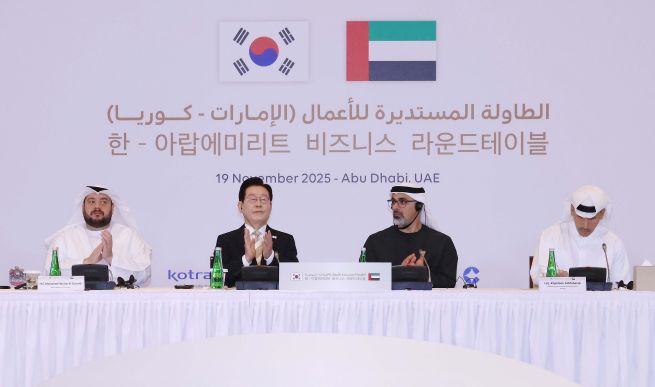
President Lee Jae Myung (2nd from L) claps during a business roundtable in Abu Dhabi, the United Arab Emirates (UAE), on Nov. 19, 2025. (From L to R) UAE Investment Minister Mohamed Hassan Al Suwaidi; Lee; Khaled bin Mohamed bin Zayed Al Nahyan, Crown Prince of Abu Dhabi and Chairman of the Abu Dhabi Executive Council; and Khaldoon Khalifa Al Mubarak, chairman of the Abu Dhabi Executive Affairs Authority. (Yonhap)
The AI Frontier
Perhaps the most ambitious element of Lee’s pitch was artificial intelligence. South Korea’s semiconductor industry, led by Samsung Electronics and SK hynix, remains one of the few global players capable of competing with American and Taiwanese rivals in advanced memory and logic chips.
Lee framed that industrial edge as a bridge to the Emirates’ projected AI future.
He positioned Korean chipmakers as “the UAE’s most reliable partner,” suggesting that the two nations could jointly develop AI infrastructure, data centers and next-generation computing platforms.
Soft Power and Cultural Diplomacy
Lee also emphasized cultural and people-to-people exchanges, mentioning Korean food, beauty products and the broader K-culture ecosystem. These, he argued, could help deepen ties across the Middle East as Korea seeks to translate its soft-power capital into economic influence.
A Delegation Reflecting Korea’s Corporate Landscape
The president’s delegation underscored the stakes: Samsung Electronics Chairman Lee Jae-yong, Hyundai Motor Group Executive Chair Euisun Chung, Hanwha Group Vice Chairman Kim Dong-kwan and LG Electronics CEO Cho Joo-wan — effectively a who’s-who of Korean industrial leadership.
A Broader Diplomatic Arc
After the business forum, the president visited South Korean troops stationed in the UAE as part of the Akh military training unit — itself a symbol of the deep defense cooperation between the two countries.
From there, Lee will travel to Cairo for talks with Egyptian President Abdel Fattah el-Sisi, before continuing to South Africa for the Group of 20 summit and Turkey for an official visit — a diplomatic arc aimed at expanding Korea’s footprint across Africa and the Middle East.
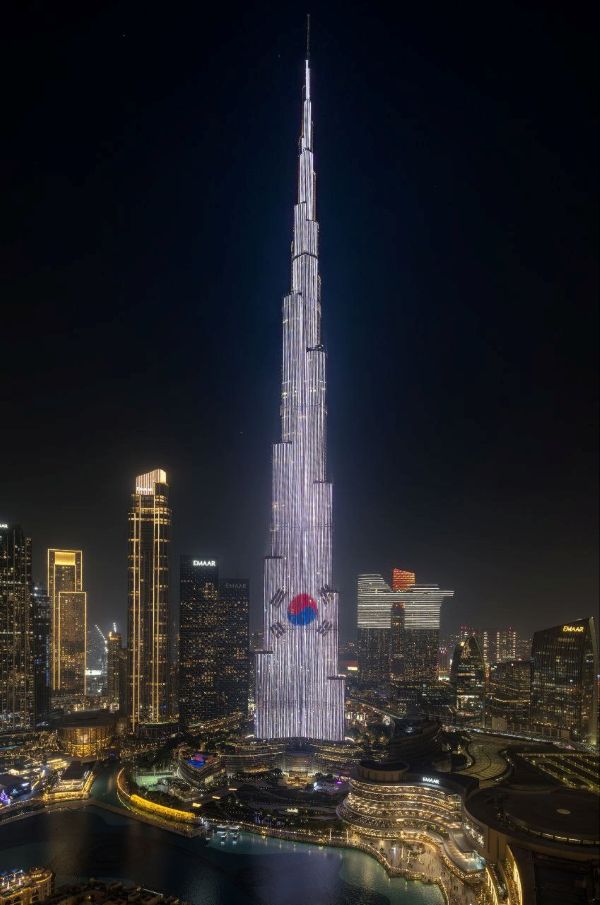
On the 18th (local time), the exterior of the Burj Khalifa, the iconic skyscraper in Dubai, United Arab Emirates (UAE), was illuminated with an image of the South Korean flag to welcome President Lee Jae-myung on his state visit. (Yonhap)
A Search for New Certainties in an Uncertain Era
The broader message of Lee’s visit is that Korea is seeking new certainties in an age when old economic models no longer guarantee success. As global competition stiffens, and as technological frontiers like AI reshape power dynamics, Seoul is testing whether partnerships with smaller but highly ambitious players can offer fresh strategic opportunities.
For the UAE — flush with capital, hungry for technology and eager to diversify beyond oil — Korea represents a capable partner with world-class industrial expertise.
For Korea — facing demographic decline, industrial maturity and geopolitical volatility — the Emirates represent a staging ground for its next economic transformation.
Whether the partnership can deliver on that promise remains uncertain, but in Abu Dhabi, Lee offered a preview of what a new Korean economic horizon might look like.
M. H. Lee (mhlee@koreabizwire.com)