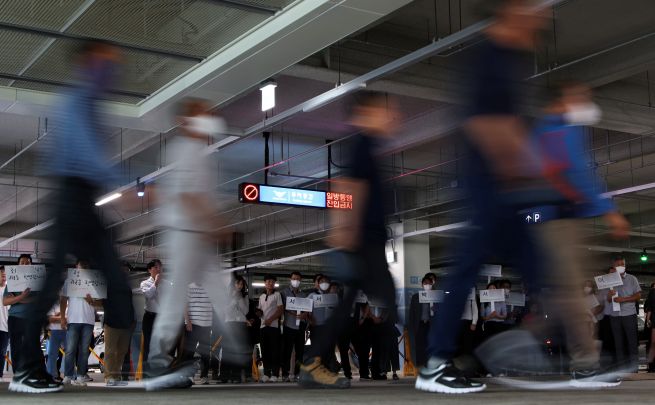
South Korean workers who had been detained in Georgia by U.S. immigration authorities arrive at Incheon International Airport’s Terminal 2 on September 12 and move to vehicles. (Yonhap)
SEOUL, Nov. 2 (Korea Bizwire) — Several South Korean companies have reportedly canceled or postponed planned investments in the United States following the detention of hundreds of Korean workers at a Hyundai Motor–LG Energy Solution battery plant in Georgia earlier this year, the Washington Post reported Saturday.
Citing multiple consultants and lawyers involved with Korean firms, the report said at least two companies have withdrawn their investment projects in the U.S., while at least four others have extended the suspension of their plans. The sources declined to identify the companies, citing client confidentiality and business sensitivity.
The shift follows the September incident in which U.S. immigration authorities detained more than 300 Korean workers during a large-scale inspection at the Georgia construction site. The workers were released after a week of negotiations between the two governments, but the episode raised alarm in Seoul’s corporate sector about the risks of doing business in the United States.
Tamy Overby, a former chair of the U.S.–Korea Business Council, told the paper that one Korean manufacturer seeking to build a U.S. plant had instead decided to expand production at home due to growing uncertainty in the American market. Chris Thomas, an immigration attorney with Holland & Hart in Denver, said a major Korean IT company had also scrapped its U.S. expansion plans and would focus on operations in Korea or India.
While Washington and Seoul have since agreed on preventive measures to avoid similar incidents, anxiety among Korean investors remains high. Thomas said that in the wake of the raid, “Japanese and Korean companies, as well as some others, told us they’re putting everything on hold for now.”
The Post also noted that President Donald Trump’s new visa restrictions and higher fees for professional H-1B visas have compounded business concerns. Consultants working with East Asian firms said many Korean employees are now reluctant to travel to the U.S., citing both immigration enforcement and an unpredictable regulatory environment.
“Employees are increasingly hesitant to accept U.S. postings,” said Jonathan Cleave, Korea head of Intralink, an international business consulting firm. “That complicates decision-making for companies.”
White House deputy spokesperson Kush Desai told the paper that President Trump “remains committed to making the United States the world’s most dynamic and investment-friendly economy.”
M. H. Lee (mhlee@koreabizwire.com)