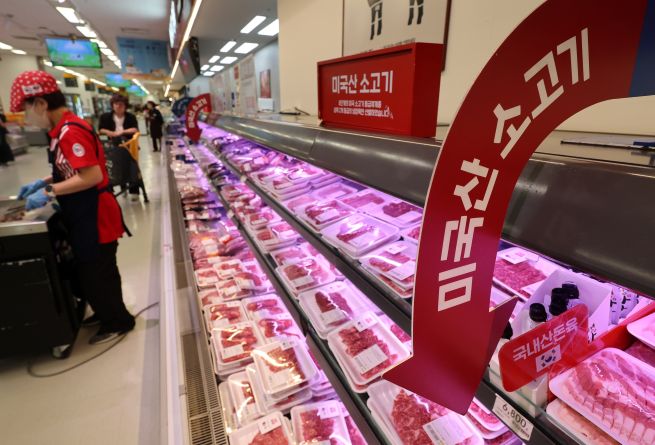
A display of U.S. beef for sale. Under the Act on Prevention of Livestock Epidemics, beef from cattle over 30 months of age originating from countries where a case of mad cow disease (BSE) has been reported within the past five years is classified as a prohibited import item. (Yonhap)
SEOUL, July 28 (Korea Bizwire) — As an August 1 deadline looms, South Korea finds itself under mounting pressure from the United States to further open its agricultural and livestock markets—a delicate issue that has long tested the country’s balancing act between international diplomacy and domestic political realities.
Behind closed doors, the two allies are racing to strike a deal to avoid the reinstatement of 25 percent reciprocal tariffs, a Trump-era measure that could rattle South Korea’s export-driven economy.
While trade officials have remained tight-lipped, the message from Washington has grown increasingly pointed: make deeper concessions—particularly on food and farming—or face the tariffs.
“It is true that the U.S. side is exerting very strong pressure in the tariff negotiations, particularly in the agricultural and livestock sectors,” Woo Sang-ho, senior presidential secretary for political affairs, said during a briefing Monday. “The government is striving to minimize concessions in order to protect domestic industries as much as possible.”
For Seoul, the stakes are high and the room to maneuver is narrow. South Korea’s agricultural sector, particularly beef and rice, remains fiercely guarded by influential farmers’ groups that have consistently opposed market liberalization.
Initially, the administration ruled out using farm trade as a bargaining chip. But with trading rivals like Japan and the European Union sealing agreements with Washington, the pressure to reach a deal has grown difficult to ignore.
Japan, one of South Korea’s closest competitors in global markets, recently secured a tariff-reduction pact with the U.S., lowering reciprocal tariffs to 15 percent in return for broader access to its automobile and agricultural sectors, and pledging a staggering $550 billion in U.S. investment.
In contrast, South Korea is reportedly offering a broader strategic package, sources say—one that includes multibillion-dollar investments in U.S. shipbuilding infrastructure and enhanced security cooperation. Yet whether that will be enough to satisfy American negotiators without Seoul surrendering ground on agriculture remains to be seen.
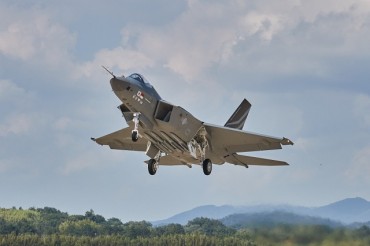
The negotiations have also touched on South Korea’s defense spending and purchases of U.S.-made weapons. Woo acknowledged these issues are “on the table” but declined to elaborate on their progress, citing the sensitivity of the talks.
As the clock ticks down, the political calculus grows more complex. Any perception of a one-sided deal could provoke backlash at home—particularly among rural voters—while failing to reach an agreement could expose Korean exporters to punishing tariffs in an increasingly competitive global landscape.
With major economies scrambling to reconfigure their trade relationships amid rising protectionism and geopolitical realignment, Seoul’s quiet but urgent talks with Washington offer a glimpse into the high-stakes diplomacy unfolding beneath the headlines.
For now, South Korea must strike a precarious balance: shielding its domestic industries while maintaining critical access to the world’s largest economy.
Ashley Song (ashley@koreabizwire.com)