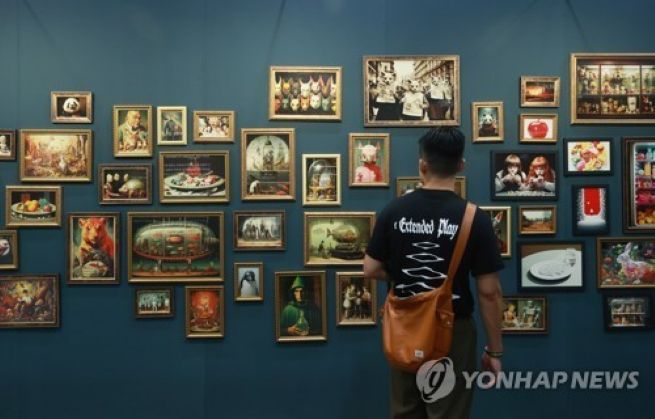
A visitor views an artwork created by artificial intelligence (AI) at “Urban Break 2023,” an art fair focused on urban and street art, held at COEX in Seoul’s Gangnam District.
SEOUL, Oct. 13 (Korea Bizwire) — When the winner of an art competition in Colorado last year turned out to be an AI-generated image, the revelation sparked outrage — and reignited a global debate: can something created by artificial intelligence truly be called art?
The question has since taken hold in South Korea, where AI-generated paintings and songs are increasingly entering public consciousness. What would happen if an AI-produced piece hung in the National Museum of Modern and Contemporary Art, or if a virtual singer topped K-pop charts? The answers, experts say, go to the heart of what creativity means in the age of algorithms.
AI Seeps Into Art and Music
Artificial intelligence has already made its way into Korea’s art scene. At recent graduation exhibitions, students from leading art schools like Hongik University used AI image generators in combination with painting and installation work. Some hailed the tools as a new medium of expression, while others questioned where human creativity ends and machine assistance begins.
The National Museum of Modern and Contemporary Art featured AI-assisted works in its 2023 media art exhibition — though all pieces still involved human creators, and no AI-only work has yet been displayed.
The K-pop industry is also experimenting rapidly. Songwriters are using AI for melody and chord suggestions, while streaming platforms have begun testing songs with AI-synthesized vocals. Though producers cite improved efficiency, artists worry about being replaced.
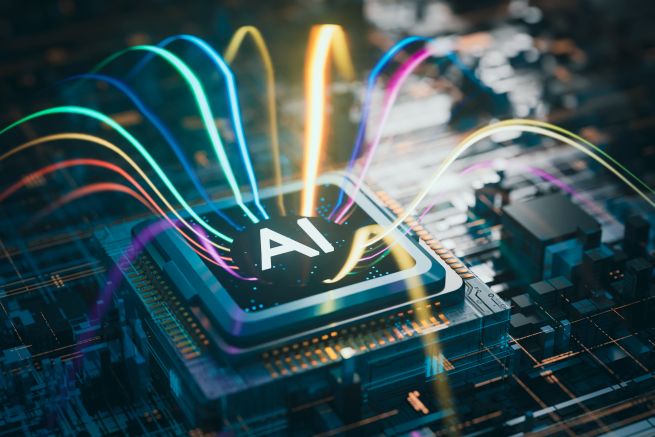
The scope of generative artificial intelligence continues to expand. (Image courtesy of Yonhap)
The Legal Line: Human Authorship and Transparency
Globally, lawmakers are trying to catch up. The United States has reaffirmed that only works with “human authorship” qualify for copyright protection, while the European Union is introducing rules requiring transparency and copyright compliance in generative models.
In March, a U.S. appeals court upheld a lower court’s ruling that AI systems cannot be considered authors — echoing the U.S. Copyright Office’s guidance that creations without “human creative input” are ineligible for protection. Meanwhile, the EU’s AI Act mandates clear disclosure of AI-generated content and data provenance.
These developments reflect a growing consensus: without proven human involvement, AI-generated works fall outside copyright, and creators must disclose data sources and preserve evidence of authorship at every stage of production.
Artists Divided Over What Counts as Creation
Reactions in the art world are mixed. Many accept AI as a tool but fear that works devoid of human context or emotion could dilute the value of creativity itself. Philosophical debates are intensifying between those who believe “art is whatever society accepts as art” and those who insist that “true art must reflect human intention and experience.”
Korea’s Approach Still Evolving
In South Korea, the Ministry of Culture and the Korea Copyright Commission are drafting guidelines on AI-generated works, seeking a balance between protecting human creators and encouraging innovation.
As AI-generated art and music grow more common — and as virtual singers like Japan’s Hatsune Miku continue to prove the market potential — the key question is shifting. No longer simply “who is the creator,” it is now “what data was used, and who bears responsibility?”
Ultimately, the future of art may hinge not on technology itself, but on three principles: transparency of origin, legality of data, and accountability of creators.
Kevin Lee (kevinlee@koreabizwire.com)