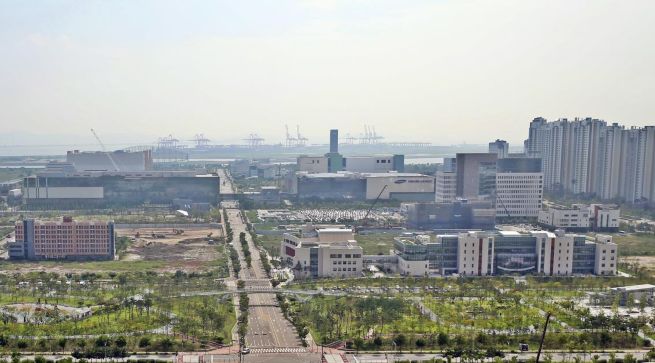
Songdo Bio Cluster (provided by the Incheon Free Economic Zone Authority)
SEOUL, Nov. 17 (Korea Bizwire) — South Korean biotechnology firms are securing multibillion-dollar licensing deals at a rapid pace, underscoring the rising global competitiveness of the country’s drug-development platforms.
According to industry data released Sunday, ABL Bio recently signed a technology-transfer agreement with Eli Lilly for its “GrabBody” bispecific antibody platform, a deal worth up to US$2.56 billion.
The platform is designed to more precisely deliver therapeutics, including its GrabBody-B system, which helps medicines cross the blood-brain barrier by targeting the IGF1R receptor. The company already inked a separate 4-trillion-won agreement with GlaxoSmithKline in April for the same technology.
Another Korean biotech, Alteogen, has built a track record of exporting its subcutaneous-injection platform ALT-B4, which converts intravenous drugs into easier-to-administer formulations.
The enzyme-based technology has drawn interest from major pharmaceutical companies: AstraZeneca’s MedImmune signed a US$1.3 billion licensing deal in March, while Japan’s Daiichi Sankyo agreed to a US$300 million contract late last year.
LegoChem Biosciences has also expanded its global footprint, transferring its antibody-drug conjugate (ADC) platform and a lead pipeline candidate to Japan’s Ono Pharmaceutical in a deal valued at up to 940 billion won.
Analysts say platform technologies—versatile systems that can be applied across multiple drug pipelines—offer “low risk, high return” potential compared with single drug development. They require less R&D investment and often secure revenue through early-stage licensing before commercial products reach the market.
The trend is drawing new entrants. Samsung EpiS Holdings has launched a subsidiary, EpiS NexLab, to develop its own biotech platforms, including peptide-based technologies.
Still, experts caution that platform licensing alone will not propel Korean firms into the ranks of global “big pharma.” Blockbuster drugs—those generating more than 1 trillion won in annual revenue—remain the primary driver of long-term corporate valuation.
ABL Bio CEO Lee Sang-hoon echoed that view at the BIO International Convention in June, urging Korean companies to pair their platform successes with more aggressive investments in full drug development.
Ashley Song (ashley@koreabizwire.com)