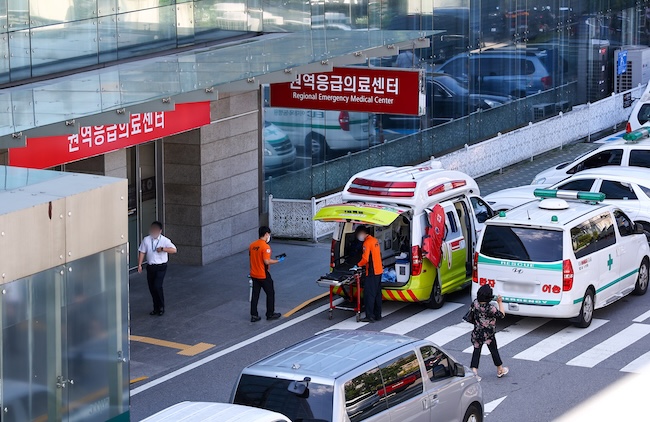
Ambulances are on standby at the emergency center of a major hospital in Seoul on Sept. 3, 2024. (Image courtesy of Yonhap)
SEOUL, July 31 (Korea Bizwire) — Early access to palliative care—not limited to hospice or end-of-life stages—can significantly reduce emergency room visits among cancer patients, according to a new study from Seoul National University Hospital.
Unlike hospice care, which is typically reserved for terminal patients with a prognosis of six months or less, palliative care focuses on symptom management and patient-centered support regardless of disease stage. It is accessible even before patients enter the final phase of illness.
The research team, led by Professors Yoo Shin-hye and Jung Ye-seol at the hospital’s Center for Palliative Care and Clinical Ethics, analyzed data from 3,560 cancer patients who received outpatient palliative care between 2018 and 2022. Their findings, released Tuesday, underscore the benefits of integrating palliative care early into cancer treatment.
Among patients who received early palliative outpatient services, only 1 in 10 visited the emergency room in the last month of life, compared to roughly 45% in earlier studies of end-of-life cancer care. Additionally, for every month earlier palliative care was initiated, the likelihood of an emergency visit in the final month decreased by 16%.
The outpatient service includes comprehensive support beyond symptom control—such as counseling on patient values and treatment preferences, and assistance with advance care planning documents like Advance Directives and Life-Sustaining Treatment Plans.
Notably, 51% of patients who had not previously completed such documents opted against futile life-prolonging interventions after receiving palliative care consultations.
“Palliative care remains a foreign concept for many in Korea, where institutional support focuses narrowly on end-stage hospice,” said Professor Yoo. “We need to expand the system so that more patients with progressive cancer can access symptom management and care planning well before the terminal phase.”
The study has been published in the journal JAMA Network Open.
Lina Jang (linajang@koreabizwire.com)