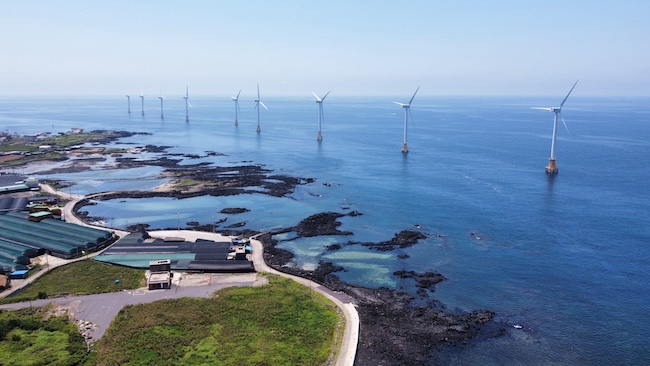
An undated file photo of a wind power plant on the southern island of Jeju (Image courtesy of Yonhap)
SEJONG, Aug. 20 (Korea Bizwire) — South Korea’s greenhouse gas emissions dropped below 700 million tons last year for the first time in nearly 15 years, driven by a shift from coal to nuclear and renewable energy.
The Ministry of Environment’s Greenhouse Gas Inventory and Research Center reported Wednesday that national emissions reached 691.6 million tons in 2024, down 2 percent from 2023 and the lowest level since 2010.
The figure also met the government’s 2024 interim target under its first Basic Plan for Carbon Neutrality and Green Growth, aligning with the nation’s pledge to cut emissions 40 percent by 2030 from 2018 levels.
Despite the decline, the report highlighted troubling signs in industry. Steel, oil refining and cement producers emitted more greenhouse gases per unit of output, suggesting that heavy industries have yet to make meaningful progress in efficiency. Industrial emissions edged up 0.4 percent overall, reversing a two-year decline during the economic slowdown.
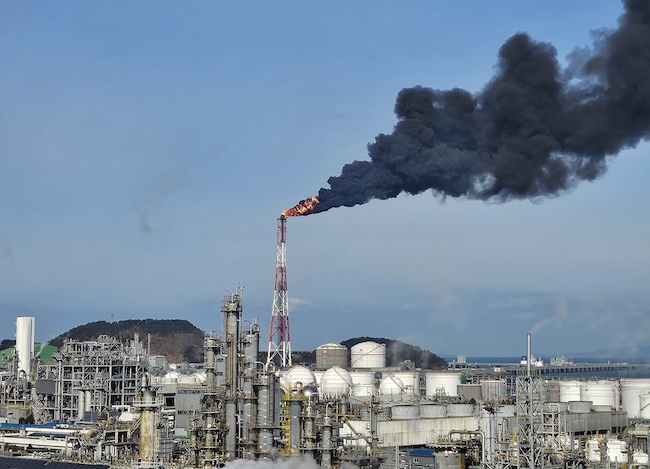
Black smoke pours out of a chemical factory chimney in the Daesan Petrochemical Complex in the central city of Seosan on Feb. 25, 2025, in this photo provided by a reader. (Image courtesy of Yonhap)
By contrast, the power sector posted a 5.4 percent drop in emissions even as electricity demand rose. Coal-fired generation fell to 167.2 terawatt-hours from 184.9 TWh, while nuclear and renewables expanded their share.
Other sectors showed mixed results. Transport emissions held steady at about 97.5 million tons, as a slowdown in electric vehicle adoption was offset by a rise in gasoline and hybrid cars.
Building-sector emissions dipped 2.8 percent, largely because of warmer winters that reduced heating demand, though overall energy consumption in buildings rose amid record summer heat. Emissions from hydrofluorocarbons — potent gases used in air conditioners — surged 4.8 percent and are projected to keep rising until at least 2034.
To stay on track for its 2030 nationally determined contribution, South Korea must cut an additional 162 million tons of emissions — requiring average annual reductions of 3.6 percent through the end of the decade.
“While emissions are declining, much of the drop reflects external factors like economic conditions and warmer weather,” said Choi Min-ji, head of the greenhouse gas center. “Achieving the 2030 target will demand far more aggressive measures, particularly a dramatic scale-up in renewable energy.”
M. H. Lee (mhlee@koreabizwire.com)