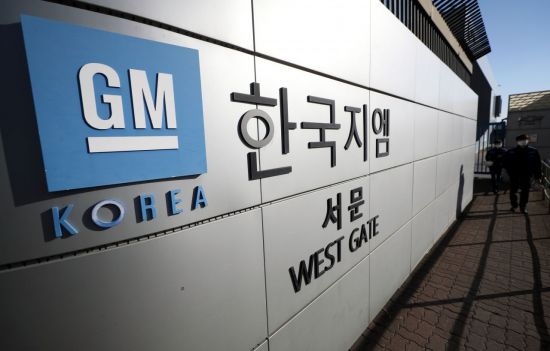
GM Korea (Image courtesy of Yonhap)
SEOUL, June 1 (Korea Bizwire) — Despite renewed speculation over a possible withdrawal of General Motors from South Korea in the wake of the Trump administration’s proposed 25% tariff on imported automobiles, GM’s top financial executive has dismissed any immediate plans to cut production at GM Korea, citing strong vehicle profitability and a favorable outlook for U.S.-Korea trade negotiations.
Speaking at the 41st Bernstein Conference on May 29, Paul Jacobson, GM’s Chief Financial Officer, emphasized that vehicles produced at GM Korea—such as the Chevrolet Trax, Trailblazer, Buick Encore GX, and Envista—continue to deliver positive profit margins and remain strategically important.
“We’re taking a wait-and-see approach,” Jacobson said, referencing the uncertainty surrounding the tariff policy. “We remain optimistic that Korea will continue to be viewed as a key partner in discussions with the Trump administration.”
His comments stand in contrast to persistent concerns in South Korea over GM’s long-term commitment to its Korean operations, which were recently intensified by GM Korea’s decision to sell certain assets.
Jacobson noted that while a 25% tariff would significantly affect cost structures, GM does not intend to rush into long-term decisions, suggesting there may still be room for policy shifts or exemptions. “We’re seeing signs that the current high probability scenario could still shift downward,” he said.
He added that GM’s Korean operations are performing “stronger than ever,” with Korean-made models enjoying robust sales in the U.S., particularly among budget-conscious consumers. Vehicles like the Trax crossover, which starts at $22,000, have become crucial alternatives in a market pressured by rising prices due to tariffs.
The Trax crossover, exclusively produced at GM Korea, currently ranks as the third-best-selling Chevrolet model in the U.S., behind only the Silverado and Equinox.
In response to surging demand, GM allocated an additional 31,000-unit production volume to its Korean subsidiary in March, increasing annual output at the Bupyeong plant from 208,000 to 240,000 vehicles in 2025.
Still, with 85% of GM Korea’s output destined for the U.S. market, industry analysts caution that prolonged tariffs could revive discussions around withdrawal. “The recent decision to sell assets has fueled exit rumors,” one auto industry insider said. “But given the high U.S. demand for Korean-made models, any such move remains far from straightforward.”
Kevin Lee (kevinlee@koreabizwire.com)