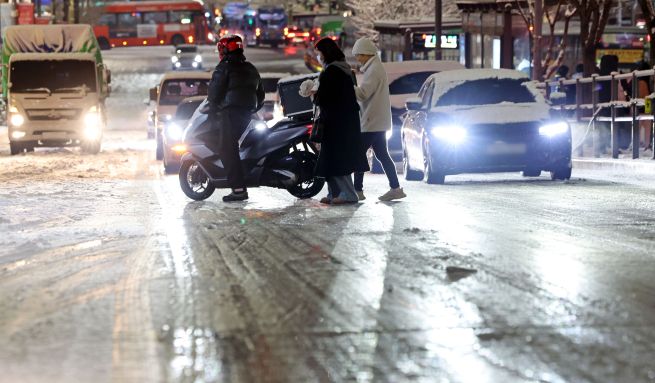
A perilous scene on the road: one side is covered in ice, the other buried in snow — a situation that leaves drivers with no easy way forward or back. (Yonhap)
SEOUL, Jan. 20 (Korea Bizwire) — Traffic accidents on icy winter roads are significantly more deadly than those occurring under normal driving conditions, South Korea’s transportation safety authority said on Monday, underscoring the dangers posed by freezing temperatures and black ice.
An analysis of national accident data from 2022 to 2024 by the Korea Transportation Safety Authority found that when roads were covered with frost or ice, nearly two people were killed for every 100 crashes — a fatality rate 55 percent higher than on dry pavement.
Specifically, accidents on icy roads resulted in an average of 1.97 deaths per 100 incidents, compared with 1.27 deaths under dry conditions, the authority said.
The heightened risk stems largely from sharply reduced braking performance. In controlled tests conducted by the agency, passenger vehicles traveling at 30 kilometers per hour required just 1.5 meters to stop on dry roads. On icy surfaces, however, stopping distances stretched to more than 10 meters — nearly seven times longer.
Heavier vehicles fared even worse. Trucks traveling at the same speed needed 12.4 meters to stop on ice, compared with 2.7 meters on dry roads, while buses required 17.5 meters, up from 3.6 meters.
Officials warned that black ice is especially common after snowfall or rain in winter, particularly on bridges, at tunnel entrances and exits, and along shaded curves where temperatures remain low.
“Drivers should slow down well in advance, maintain sufficient distance from the vehicle ahead and avoid sudden steering or braking,” said Jeong Yong-sik, head of the safety authority. “These basic precautions are essential for preventing serious accidents during winter conditions.”
The findings come as winter weather continues to pose seasonal risks across the country, prompting renewed calls for caution as freezing temperatures persist.
M. H. Lee (mhlee@koreabizwire.com)