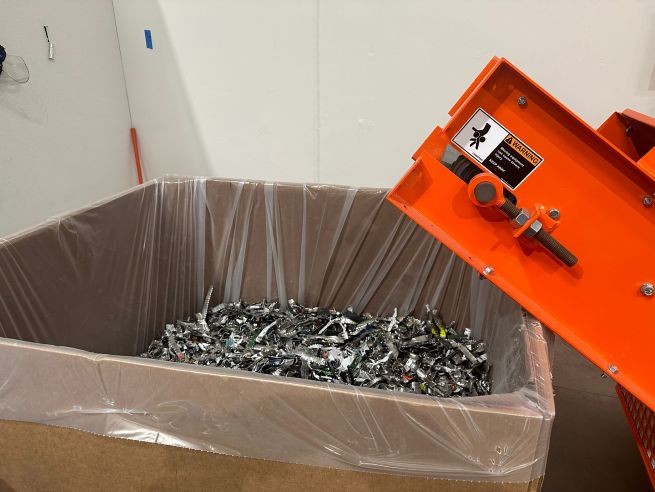
Fragments of IT devices shredded for recycling at the Las Vegas plant of TES, the recycling-focused subsidiary of SK ecoplant. (Image courtesy of SK ecoplant.)
SEOUL, Jan. 8 (Korea Bizwire) — South Korea has taken a step to strengthen its supply of strategic minerals by formally recognizing recycling and recovery from waste as a distinct industrial sector, a move aimed at shoring up domestic supply chains for materials critical to advanced manufacturing.
The Ministry of Trade, Industry and Energy said Thursday that it has introduced a new special industrial classification for the “re-resourceization” of core minerals, developed in cooperation with the National Data Agency and the Korea Mine Rehabilitation and Mineral Resources Corporation.
The new framework is intended to make it easier to track, support and expand an industry seen as increasingly vital to economic and national security.
Until now, companies that extract key minerals from discarded products—such as used batteries and spent catalysts—were scattered across existing categories like manufacturing or waste processing. That fragmentation, officials said, made it difficult to assess the industry’s scale, collect reliable data or design targeted support policies.
With the new classification in place, the government plans to conduct detailed surveys of the sector and build a more systematic statistical base, using the findings to identify weaknesses and focus policy support.
Companies included in the new category will also be given priority in a government program launching this year to subsidize facilities and equipment for core mineral recycling.
The ministry said it would work with other government agencies to ease regulations affecting recycling firms, including helping them move into industrial complexes and relaxing certain waste-related rules, as part of a broader effort to nurture the sector.
Roughly 200 companies are currently engaged in mineral re-resourceization in South Korea, but most are small in scale, and their activities are concentrated on a narrow range of materials. Officials said stronger policy backing and regulatory reform would be needed to improve competitiveness and broaden the scope of recovered minerals.
“This special classification is the first step toward recognizing re-resourceization as a core mineral manufacturing industry,” Yoon Chang-hyun, director general for resource industry policy at the ministry, said in a statement.
He added that the government would push ahead with policies to build a robust recycling ecosystem and reduce South Korea’s reliance on overseas supplies of strategic minerals.
M. H. Lee (mhlee@koreabizwire.com)