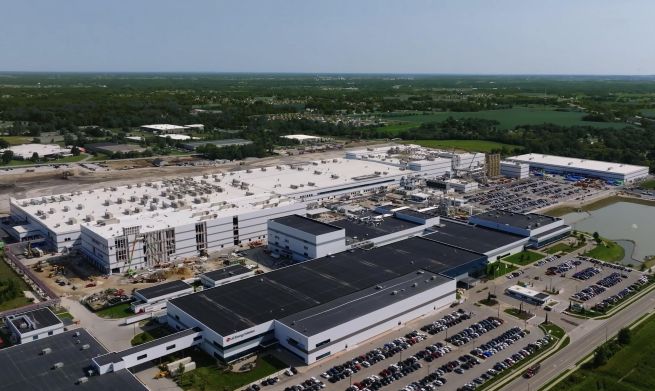
LG Energy Solution’s plant in Holland, Michigan, U.S. (Image provided by LG Energy Solution)
SEOUL, April 30 (Korea Bizwire) — South Korea’s major battery makers are increasingly reliant on U.S. subsidies under the Inflation Reduction Act (IRA) as a prolonged slump in electric vehicle (EV) demand—known as the “EV chasm”—drags on, clouding earnings prospects and investment strategies. Now, growing political uncertainty in Washington is further complicating the industry’s outlook.
Companies like LG Energy Solution, Samsung SDI, and SK On have benefited from the Advanced Manufacturing Production Credit (AMPC), a tax incentive introduced as part of the IRA, aimed at bolstering clean energy manufacturing in the U.S.
While the credit has provided a critical earnings lifeline, its long-term future could be in question if President Donald Trump, known for his protectionist policies, moves to scale back or repeal the IRA should his administration solidify control.
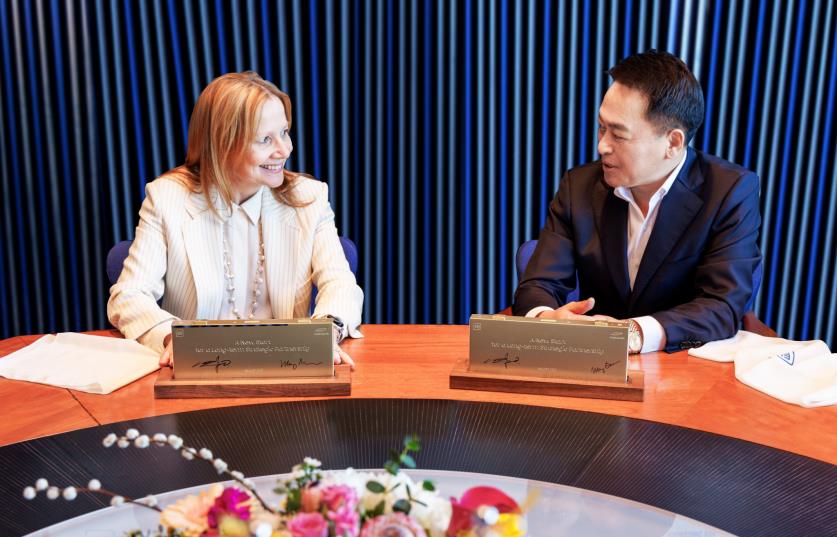
Samsung SDI President and CEO Choi Yoon-ho (right) and General Motors Chairwoman Mary Barra signing a memorandum of understanding (MOU) in March 2023 to establish a joint venture for EV battery manufacturing. (Image provided by Samsung SDI)
Subsidies Cushion Declining Margins
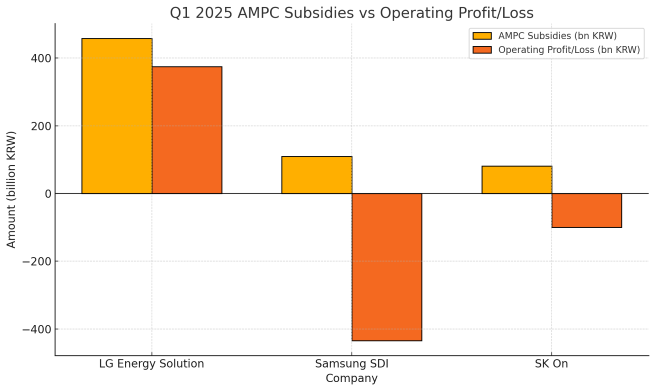
LG Energy Solution reported a first-quarter operating profit of 374.7 billion won ($258 million), a 138.2% increase from the previous year. However, this gain was largely driven by AMPC subsidies, which totaled 457.7 billion won—up 21% from the previous quarter. Without the subsidy, the company would have recorded an operating loss of 83 billion won, narrower than the 602.8 billion won deficit in Q4 of 2024.
Samsung SDI received 109.4 billion won in AMPC subsidies during the same period but still posted a 434.1 billion won operating loss, swinging from a 249.1 billion won profit a year earlier. SK On, which has yet to release its Q1 earnings, is also expected to remain in the red despite receiving 81.3 billion won in subsidies last quarter.
These companies began investing in U.S. manufacturing early, allowing them to qualify for the tax credit. With EV demand stagnating, the subsidy has become a key buffer against deepening losses.
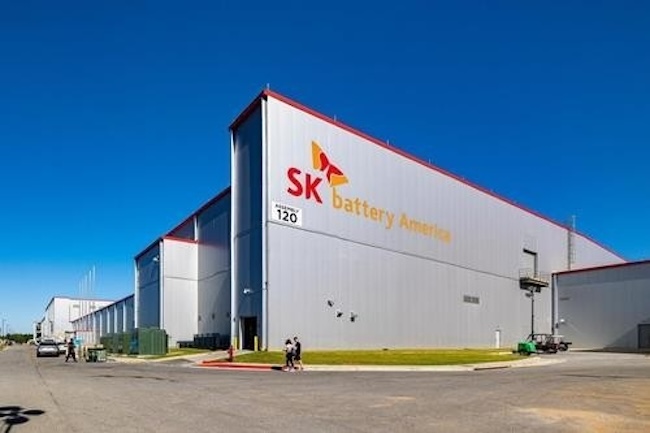
SK Battery America (Image courtesy of SK On)
Uncertainty Grows Under Trump Administration
Despite Trump’s history of skepticism toward climate-focused policies, industry analysts believe the AMPC will likely remain in place at least through 2026.
“Even if tariffs rise under Trump, there’s a limit—any sharp increase would risk weakening U.S. manufacturing competitiveness,” said Anna Lee, an analyst at Yuanta Securities. “We expect the IRA won’t be immediately repealed but could face gradual revisions.”
South Korean battery firms continue to ramp up U.S.-based operations. LG runs three battery plants in Michigan, Ohio, and Tennessee, and is building additional sites with Honda, Hyundai, and General Motors.
SK On operates SK Battery America in Georgia and is constructing a joint plant with Hyundai, set to open in early 2026. Samsung SDI, which was late to the U.S. market, has accelerated its rollout with joint factories alongside Stellantis and GM.
New Headwinds from Trade Policy
Tariffs are emerging as a new risk. The U.S. recently imposed a 125% retaliatory tariff on Chinese goods, potentially benefitting Korean firms with U.S.-based operations, as those products are excluded from the tariff list. However, many battery materials and components are still sourced overseas, creating cost pressures.
Moreover, automakers manufacturing outside the U.S.—particularly in Canada and Mexico—may face higher costs if new tariffs apply, ultimately depressing EV demand. LG Energy Solution acknowledged during its earnings call that several major automakers are reassessing their North American strategies, likely leading to more conservative inventory management.
Samsung SDI echoed the concern, warning that prolonged tariff volatility could weigh on performance. “If the situation continues, we could see broad price increases and an overall slowdown in demand,” the company stated.
Pivot to Energy Storage and Localized Supply
To hedge against EV sector volatility, battery makers are accelerating investment in energy storage systems (ESS). LG Energy Solution plans to repurpose its Michigan facility for ESS production a year ahead of schedule, abandoning earlier plans for a new Arizona plant. Samsung SDI is also evaluating ESS expansion in the U.S.
Despite uncertainty, the industry anticipates gradual recovery. “Q2 results may not fully meet expectations due to rising tariff risks, but should significantly improve from Q1,” Samsung SDI said. “We expect to build momentum through the remainder of 2025, staying agile in a volatile macro environment and working closely with clients to navigate the challenges ahead.”
Kevin Lee (kevinlee@koreabizwire.com)