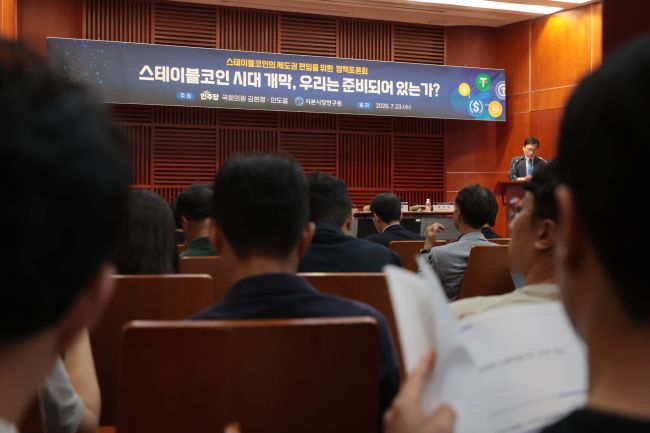
Kim Se-Wan, President of the Korea Capital Market Institute (KCMI), delivered the opening remarks at an event held at the Korea Finance Investment Center in Yeouido, Seoul, on the 23rd. (Image courtesy of Yonhap)
SEOUL, July 25 (Korea Bizwire) — As discussions intensify around the adoption of Korean won-based stablecoins, credit card companies in South Korea are scrambling to respond, concerned about potential disruption to their traditional role in the payments ecosystem.
According to financial industry sources on Thursday, the Credit Finance Association and eight major credit card companies plan to launch a stablecoin task force (TF) next week.
The group will explore how the industry should respond to stablecoin legislation and what role card firms might play in the evolving digital payments landscape.
Stablecoins—cryptocurrencies pegged to fiat currencies like the Korean won—could enable direct transactions between consumers and merchants, potentially bypassing credit card networks and weakening the relevance of card companies and payment gateways (PGs).
A card industry official said the main purpose of the task force is to assess the impact of stablecoin adoption and explore how the industry can take a proactive, leadership role in shaping the new ecosystem.
The group also plans to propose to financial regulators that credit card companies be allowed to participate in operating stablecoin platforms, which would require legal amendments to the Specialized Credit Finance Business Act.
Meanwhile, major credit card firms have been racing to secure trademark rights related to won-based stablecoins. On July 18, Lotte Card filed 36 trademark applications, including 12 Korean brand names such as Wonbit, K-Token, and LocaMoney, and 24 ticker-style labels commonly used on crypto exchanges.
Lotte Card said it envisions stablecoins being used in high-value asset transactions, such as used cars, luxury goods, real estate, and gold, and hopes to leverage its broad distribution network and prepaid services for foreign tourists as competitive advantages in the space.
Other card companies have followed suit. Shinhan Card was the first to file, registering eight trademarks including SHCw and SKRW in late June. KB Kookmin Card has filed 35 applications, and Woori Card nine.
While the future of stablecoin regulation in Korea remains uncertain, industry players appear determined to position themselves not just defensively, but as potential stakeholders in the emerging digital currency infrastructure.
“As there’s no clear regulatory direction yet, we don’t see stablecoins only as a threat,” said one card company representative. “We’re exploring a wide range of potential business opportunities.”
M. H. Lee (mhlee@koreabizwire.com)