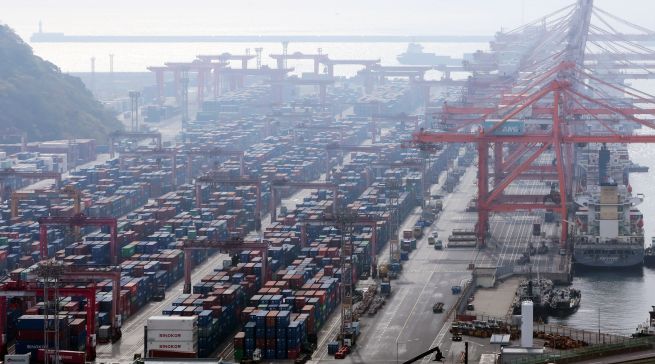
The photo shows stacks of containers at Busan’s Sinseondae Terminal on December 1. (Yonhap)
SEOUL, Jan. 19 (Korea Bizwire) — South Korean companies filed a record number of trade-remedy petitions last year, turning increasingly to anti-dumping investigations as protectionist pressures mounted worldwide and low-priced imports—largely from China—flooded the domestic market.
According to data released Sunday by the Trade Commission under the Ministry of Trade, Industry and Energy, Korean firms submitted 13 anti-dumping petitions in 2025, the highest annual total since records began in 2002. Nine of the cases targeted Chinese exporters, followed by three involving European Union companies and one involving Japan.
The surge comes as the second Trump administration in the United States has pushed aggressive, unilateral tariff policies, reinforcing a global shift toward trade protection. At the same time, chronic oversupply in China has intensified exports of low-priced goods, squeezing Korean manufacturers already grappling with structural challenges.
Of the 13 petitions filed last year, the commission formally launched investigations into 10 cases. Steel and nonferrous metal products accounted for four, while chemical products made up three—reflecting the strain on mature industries facing both global overcapacity and slowing domestic demand.
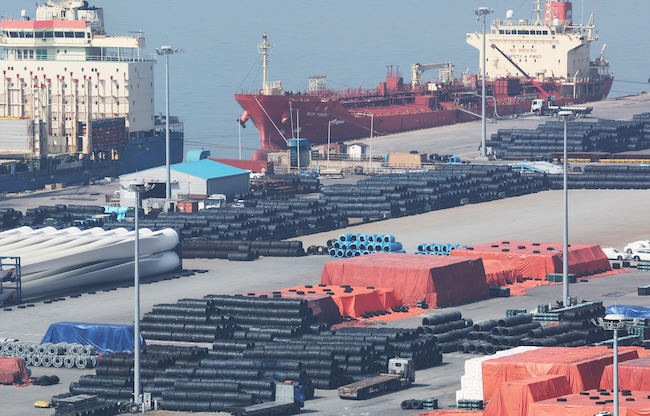
Steel products are piled up at a port in Pyeongtaek, about 65 kilometers south of Seoul, on March 11, 2025, a day before the U.S. government’s 25 percent tariffs on all steel and aluminum imports kick off. (Image courtesy of Yonhap)
In one high-profile case, the commission issued a preliminary ruling that dumped imports of carbon and alloy hot-rolled steel from China and Japan had caused material injury to Korea’s steel industry, imposing provisional anti-dumping duties ranging from 28.16 percent to 33.57 percent. Korean steelmakers have long warned that surging Chinese exports were distorting market conditions and undermining fair competition.
The commission also imposed provisional duties of up to 42.81 percent on imported PVC paste resin used in construction materials, following a complaint by Hanwha Solutions. The ruling covered producers in Germany, France, Norway and Sweden, with duty rates varying by company.
Trade-remedy actions extended beyond traditional heavy industries into advanced manufacturing. At the request of HD Hyundai Robotics, the commission found dumping and injury in imports of multi-axis industrial robots—used in automobile assembly, logistics automation and metal processing—and imposed provisional duties of 21.17 percent to 43.60 percent on suppliers from Japan and China, including major global brands.
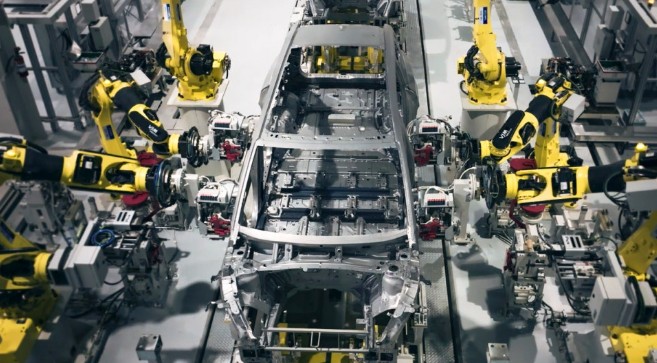
Interior view of Hyundai Motor Group Metaplant America (HMGMA) facility
Additional measures included provisional tariffs on fiberboard imports from Thailand, underscoring the government’s broader push to shield domestic industries from unfair trade practices.
The administration expanded the Trade Commission’s staffing and authority in March last year to strengthen enforcement, citing the rapid spread of global protectionism and rising trade frictions.
Yet South Korea remains a frequent target abroad. World Trade Organization data show that between 1995 and 2024, Korea was the world’s second-most targeted country in anti-dumping cases, after China, and the fourth-most targeted in countervailing duty investigations.
The figures highlight the increasingly contested terrain of global trade—one in which Korea is simultaneously stepping up defenses at home while facing sustained scrutiny overseas.
M. H. Lee (mhlee@koreabizwire.com)