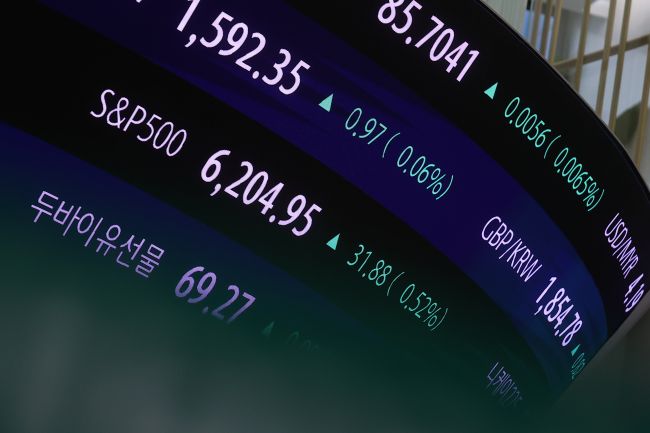
S&P 500 shown on the trading board at Hana Bank’s main dealing room in central Seoul. (Image courtesy of Yonhap)
SEOUL, Sept. 10 (Korea Bizwire) — South Korea’s financial watchdog cautioned retail investors on Tuesday about the risks of exchange-traded funds (ETFs), even as the market for such products has expanded more than fourfold in recent years.
According to the Financial Supervisory Service (FSS), the nation’s ETF market reached 232 trillion won ($168 billion) in assets under management at the end of August, compared with 52 trillion won at the end of 2020. The number of listed ETF products also surpassed 1,000 for the first time since their introduction to Korea in 2002.
The regulator noted that while ETFs offer advantages such as low-cost diversification, many newer funds employ complex structures, including distribution-based products and derivatives-linked strategies, which can be easily traded but are not always well understood.
Dividend ETFs and Misconceptions
In particular, the FSS highlighted potential pitfalls in so-called distribution ETFs, which pass along dividends or interest income to investors. A high payout ratio does not necessarily translate into higher returns, the agency warned, since the fund’s net asset value declines by the amount distributed — an effect similar to a stock’s ex-dividend adjustment.

The Financial Supervisory Service. (Image courtesy of Yonhap)
Cost Transparency and Tracking Errors
The regulator also urged investors to scrutinize the total expense ratio (TER) — which includes management fees, sales charges, licensing fees and other operational costs — as such expenses weigh more heavily on long-term returns.
Additionally, the FSS pointed to risks related to tracking errors, when an ETF’s net asset value diverges from the index it follows, and premium or discount spreads, when the fund’s market price strays too far from its underlying value.
Caution Against Social Media Hype
The agency warned that ETFs employing options strategies can be particularly opaque and should be evaluated carefully in light of market conditions. It also advised investors to avoid relying solely on recommendations from YouTube or other social media platforms, and instead consult official prospectuses and risk disclosures provided by fund managers.
With the ETF market now entrenched as a core part of Korean retail investment, regulators appear determined to temper enthusiasm with reminders that easy access and glossy distribution yields do not eliminate the possibility of loss.
M. H. Lee (mhlee@koreabizwire.com)