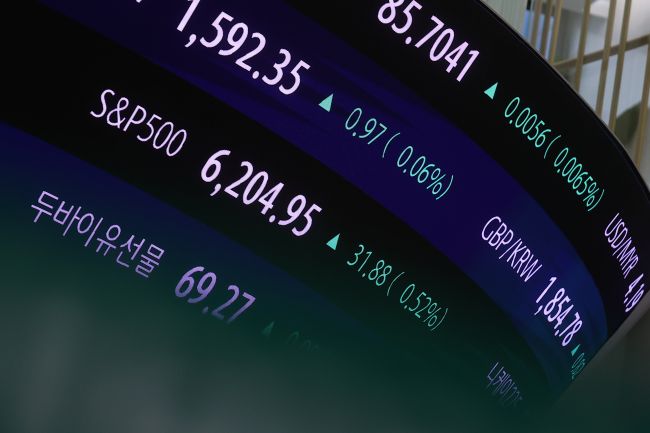
S&P 500 shown on the trading board at Hana Bank’s main dealing room in central Seoul. (Image courtesy of Yonhap)
SEOUL, Aug. 20 (Korea Bizwire) — A significant share of South Korean investors’ holdings in overseas-listed exchange-traded funds (ETFs) are concentrated in high-risk leveraged products, raising concerns about potential losses and the need for regulatory overhaul, according to a new report by the Korea Capital Market Institute.
As of June 2025, South Korean investors held approximately 50.5 trillion won ($38.5 billion) in overseas-listed ETFs. Notably, 43.2% of these holdings were in leveraged or inverse ETFs—products that aim to amplify daily returns of underlying assets by two or three times, either positively or negatively.
These instruments are widely recognized for their volatility and are often unsuitable for long-term investment.
More strikingly, 22.2% of these holdings were in triple-leveraged products, which are prohibited for retail investors in South Korea. Roughly one-third of the leveraged ETF exposure was concentrated in single-stock derivatives—adding another layer of risk.
From January to June this year, 72% of trading volume by South Koreans in overseas derivative ETFs was in ±2x and ±3x products, highlighting a strong appetite for short-term, speculative gains.
New York Stock Exchange. (Image courtesy of Yonhap)
“This trend is becoming increasingly pronounced,” said research fellow Kim Min-ki, author of the report. “Domestic investors, driven by high risk tolerance, are actively using volatile overseas derivative ETFs.”
The report also links this behavior to tax advantages. In Korea, locally listed ETFs that track foreign indices are taxed as trust-based funds, subjecting both capital gains and distributions to dividend income tax—potentially up to 49.5% for high-income investors.
In contrast, foreign-listed ETFs are taxed more favorably: capital gains are treated as separate taxable income under capital gains tax (22%), and are excluded from aggregated financial income, making them more attractive for affluent investors.
This tax discrepancy, combined with regulatory limitations on product variety in Korea, has structurally pushed domestic investors toward riskier overseas ETFs.
The popularity of these products has even influenced regulatory moves abroad, including the recent allowance of single-stock leveraged/inverse ETFs in Hong Kong.
“Investor demand for high-risk products in Korea may have influenced international regulatory decisions,” Kim noted.
The report concludes by urging Korean policymakers to address the growing structural imbalance through tax reform and harmonization of regulations across domestic and foreign investment products.
“It’s not a temporary trend,” Kim said. “It’s a systemic issue stemming from a mismatch of taxation, regulation, and investor preferences. Policy adjustments are essential to enhance competitiveness and diversity in Korea’s ETF market.”
M. H. Lee (mhlee@koreabizwire.com)