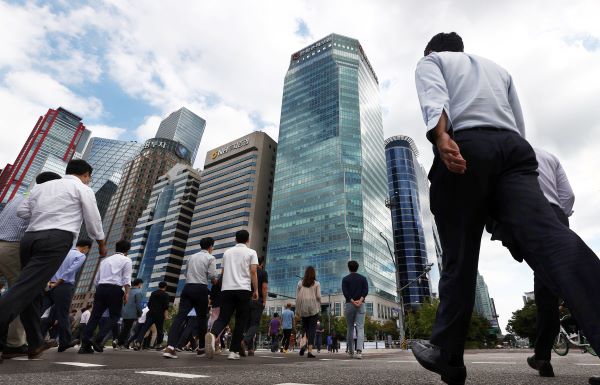
Office workers in Yeouido stepping out to eat during their lunch break (Image courtesy of Yonhap)
SEJONG, Sept. 26 (Korea Bizwire) —South Koreans earn the most at age 45 but begin running deficits by 61, as consumption outpaces income in later life, according to new government data that underscores the economic strains of an aging society.
The National Statistics Office said Wednesday in its release of the 2023 National Transfer Accounts that Koreans in their mid-40s recorded peak annual labor income of 44.3 million won ($32,000), while net surpluses — income exceeding consumption — were highest at 17.5 million won. But by 61, average citizens fell back into deficit as retirement cut labor earnings while health and other living costs climbed.
Young people also ran steep deficits: at age 16, the average shortfall was 44.2 million won, largely due to education expenses. On average, Koreans did not move into surplus until 28, a threshold that has held steady since 2010. By contrast, the onset of old-age deficits has shifted later, from age 56 in 2010 to 61 last year, reflecting the growing share of older adults working past retirement.
Overall, life-cycle deficits — the gap between total consumption and labor income — surged 15.9 percent from a year earlier to a record 226.4 trillion won in 2023, marking the first time the figure exceeded 200 trillion. Consumption rose 7.0 percent to 1,459 trillion won, outpacing a 5.5 percent increase in labor income. Growth was led by private health spending, which climbed 8.3 percent, and public education expenditures, up 7.7 percent.
The data highlights how intergenerational transfers help bridge the gaps. Working-age adults (15 to 64) transferred a net 320.7 trillion won in 2023, of which 184.5 trillion went to children and 131.1 trillion to seniors. Public transfers, largely through taxes and social programs, accounted for most of the flows, while private transfers — including inheritances and family support — made up the rest.
By age group, deficits for children under 15 rose 4.3 percent to 184.4 trillion won, while senior citizens’ deficits grew 10.3 percent to 179.2 trillion. The working-age population maintained a surplus of 137.2 trillion, though that figure fell 4.7 percent from the prior year.
The findings underline the mounting fiscal and social pressures as South Korea grapples with longer life spans, rising health costs and a widening gap between consumption and income in old age.
Ashley Song (ashley@koreabizwire.com)