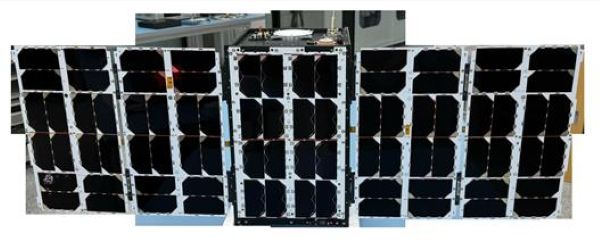
Space Verification Satellite (E3T-1) (Photo courtesy of the Korea AeroSpace Administration)
SEOUL, Dec. 19 (Korea Bizwire) — South Korea has begun in-orbit testing of domestically developed space components, marking a key step toward greater technological self-reliance in its space industry.
The Korea Aerospace Administration and the Korea Aerospace Research Institute said Thursday that they have confirmed normal operations of E3T-1, a space verification satellite developed under a government program to test locally made electronic components in actual space conditions. The satellite has now begun its primary payload verification mission.
Launched aboard the Nuri rocket on Nov. 27 last year, E3T-1 successfully established two-way communication in April and has since completed initial system checks and payload trial operations without issues. The satellite will conduct verification missions for up to 12 months in low Earth orbit at an altitude of about 600 kilometers.
E3T-1 was designed to evaluate the radiation tolerance and space durability of Korean-made components, supporting efforts to reduce reliance on foreign space-grade parts. The 12U-class satellite—measuring roughly 20 by 20 by 30 centimeters—was jointly developed by the aerospace research institute and Nara Space Technology.
Its payload includes DRAM and NAND flash memory from Samsung Electronics, custom ADC and DAC semiconductor chips developed by the Korea Advanced Institute of Science and Technology, and several domestically produced space-grade components, including SRAM supplied by MID.
“With the start of E3T-1’s space verification mission, we can now secure real flight heritage for domestically developed components,” said Han Chang-heon, head of the space and aerospace industry bureau at the Korea Aerospace Administration. He added that the government plans to continue providing in-orbit testing opportunities to support South Korea’s broader ambitions in space technology.
Kevin Lee (kevinlee@koreabizwire.com)