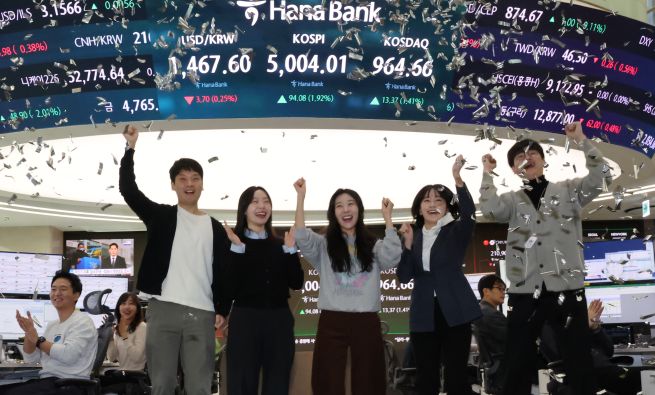
Currency traders rejoice in the dealing room of Hana Bank in Seoul on Jan. 22, 2026, as a financial data screen shows the benchmark Korea Composite Stock Price Index having topped the 5,000-point level in early trading. South Korean stocks opened sharply higher and hit another intraday record. (Yonhap)
SEOUL, Jan. 22 (Korea Bizwire) — South Korea’s benchmark stock index surged past the long-symbolic 5,000 mark on Thursday, propelled not by a single sector but by a widening rally that rotated from semiconductors into automobiles, defense, nuclear power and other heavyweight industries.
The Korea Composite Stock Price Index, or KOSPI, climbed 1.89 percent in early trading to reach 5,002.88, crossing the threshold often referred to by investors as “Ohcheonpi,” or the dream level of 5,000 points.
The milestone was achieved after weeks of sustained gains that began late last year, initially driven by optimism surrounding artificial intelligence and a global semiconductor upcycle. Shares of Samsung Electronics and SK Hynix — the market’s two largest stocks — led the early phase of the rally, rising nearly 40 percent each between early December and early January.
But as global semiconductor stocks entered a period of consolidation and valuation concerns mounted, momentum in those shares began to fade. Under normal circumstances, weakness in the two chipmakers — which together account for more than 35 percent of the KOSPI’s market capitalization — would have weighed heavily on the index.
This time, the market behaved differently.
Even on days when both stocks declined, the index continued to climb, reflecting a clear rotation of capital into other large-cap sectors.
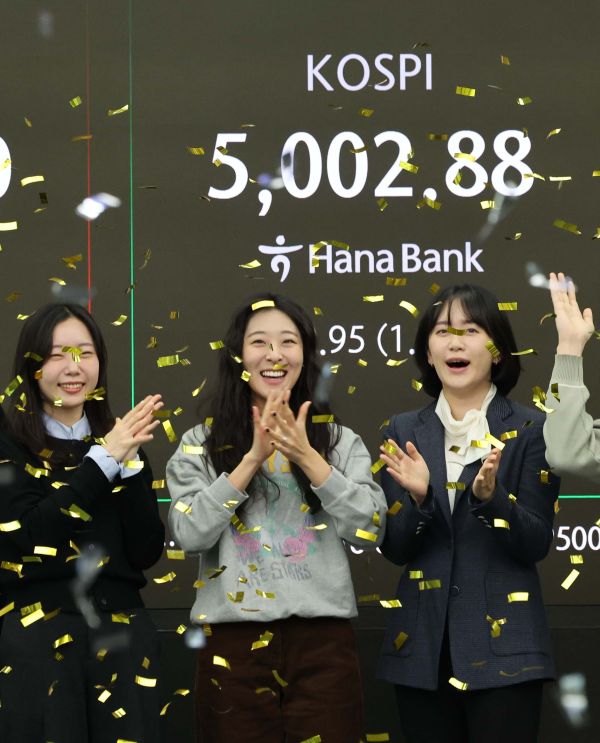
Currency traders rejoice in the dealing room of Hana Bank in Seoul on Jan. 22, 2026, as a financial data screen shows the benchmark Korea Composite Stock Price Index having topped the 5,000-point level in early trading. South Korean stocks opened sharply higher and hit another intraday record. (Yonhap)
Automobile-related shares surged after Hyundai Motor Group unveiled its humanoid robot Atlas at CES 2026 in Las Vegas earlier this month. Since the event, shares of Hyundai Motor nearly doubled, while affiliated companies including Hyundai Mobis, Hyundai Glovis and Hyundai AutoEver posted gains ranging from 30 to more than 50 percent.
Defense stocks also rallied amid heightened geopolitical tensions, with companies such as Hanwha Aerospace, Korea Aerospace Industries and Hyundai Rotem posting double-digit gains this month.
Meanwhile, expectations for overseas nuclear power plant contracts drew strong buying interest into nuclear and construction-related stocks, further reinforcing the market’s upward momentum.
Market analysts said the index’s resilience reflects a rare phase of sector rotation, in which leadership continuously shifts rather than collapsing once a dominant theme cools.
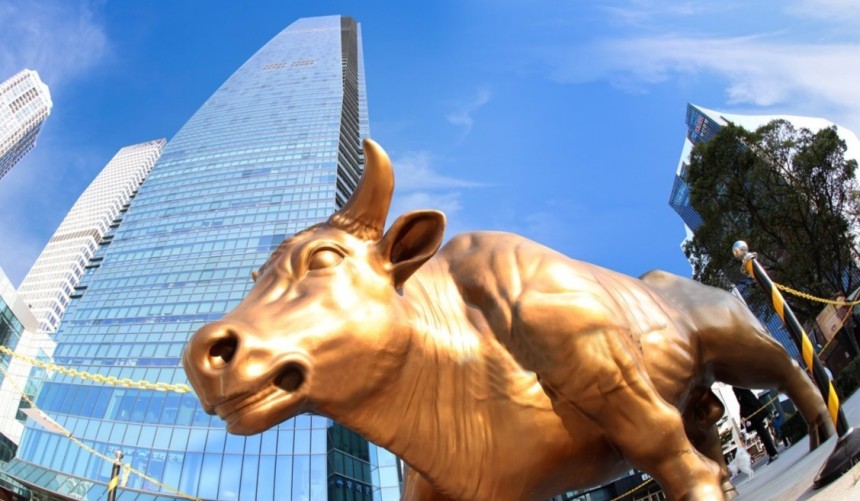
The bull statue installed in front of the Korea Exchange (Image courtesy of Yonhap)
“The semiconductor, automotive and defense industries are all sustaining long-term growth cycles,” said Lee Kyung-min, an analyst at Daishin Securities. He added that consumer-related sectors — including cosmetics, apparel, travel and retail — could emerge as the next beneficiaries depending on shifts in regional diplomatic sentiment.
Han Ji-young, an analyst at Kiwoom Securities, said that after clearing the 5,000-point milestone, the market is likely to transition into a more selective phase, with gains driven increasingly by individual stocks rather than broad sector rallies.
For now, investors appear convinced that the rally’s foundation has widened enough to carry the market into unfamiliar territory — even as leadership continues to change hands.
Ashley Song (ashley@koreabizwire.com)