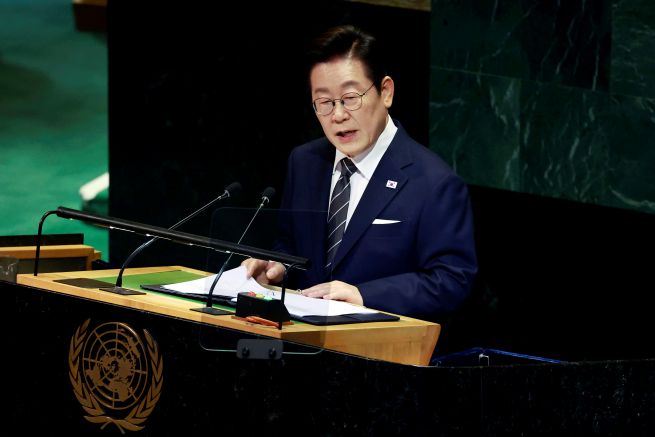
President Lee Jae-myung delivers a keynote speech at the U.N. General Assembly Hall in New York on September 23 (local time) (Yonhap)
NEWYORK, Sept. 24 (Korea Bizwire) — President Lee Jae-myung of South Korea chaired a United Nations Security Council debate on artificial intelligence and international security on Wednesday, marking the first time a South Korean leader has presided over an open council session.
The event reflected Seoul’s rotating presidency of the body this month and underscored Korea’s growing ambition to shape global governance on emerging technologies.
Lee opened the meeting at U.N. headquarters in New York by invoking computer scientist Geoffrey Hinton’s warning that AI is like a “baby tiger” — a force that could grow into either a dangerous predator or a benign companion.
He warned that if nations fail to prepare, the resulting “silicon curtain” could deepen inequality more severely than the iron curtain of the Cold War.
“The only way to turn the dual nature of AI into an opportunity is for the international community to unite around the principle of responsible use,” Lee said. He cautioned that if experts’ warnings of AI-driven existential risks materialize, “it will be because we failed to create shared norms.”
Lee argued that while AI cannot be resisted like the Luddite movement once attempted with industrial machinery, nations must find ways to compete in their national interest while cooperating for the common good.
He highlighted both the promise of AI — from monitoring weapons of mass destruction to preventing conflict — and the perils, including disinformation, cyberattacks and an arms race that could destabilize global security.
The South Korean leader pledged that his country would act as a “responsible global power” to ensure AI contributes to a sustainable future. He said Seoul is working through the Asia-Pacific Economic Cooperation forum to launch an “APEC AI Initiative” aimed at spreading the benefits of technology inclusively.
Lee framed the debate as a historic inflection point, likening today’s challenge of AI governance to the U.N.’s founding concern 80 years ago of managing the threat of nuclear weapons.
“Humanity must defend the universal values we have long shared and turn the coming transformation into a springboard for renewal,” he said.
South Korea has chaired the Security Council only three times since joining the U.N. in 1991. Lee described the role as a symbolic opportunity for a nation that rose from war devastation to democracy and prosperity with U.N. support, now seeking to shape rules for the next frontier of international security.
M. H. Lee (mhlee@koreabizwire.com)