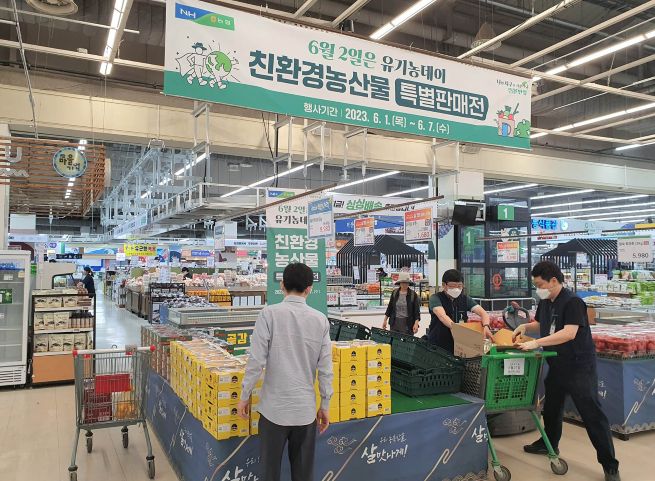
A special promotional event for eco-friendly agricultural products is being held at a NongHyup retail store. (Image provided by NongHyup)
SEOUL, June 10 (Korea Bizwire) — A growing number of South Korean consumers are purchasing eco-friendly agricultural products, but high prices continue to hinder broader adoption, according to a government survey released Monday.
The Ministry of Agriculture, Food and Rural Affairs reported that 76.8% of respondents said they had purchased eco-friendly produce at least once in the past year—a slight increase of 0.6 percentage points from 2024.
Consumers cited perceived safety (39.5%) and family health (31.1%) as the primary reasons for choosing eco-labeled produce, while environmental protection (13.6%) also factored in. Taste and quality were less significant motivators, at 4.8% and 3.1%, respectively.
However, price remains the dominant barrier: 65.1% of those who refrained from buying eco-friendly products said they were deterred by higher costs compared to conventional alternatives.
Strawberries, tomatoes, mushrooms, and leafy vegetables were among the most frequently purchased items. The majority of consumers (68.1%) bought these products at large supermarket chains, although online purchasing—especially through early-morning delivery services—has been steadily rising, accounting for over 35% of transactions in 2025.
Despite the uptick in consumer interest, the market saw a decline in total sales. The number of online and offline eco-friendly retail outlets rose to 6,099 in 2024, but overall revenue dropped by 158.3 billion won to 2.04 trillion won, with sales of certified organic products falling by 81.3 billion won to 904.5 billion won. Most retailers attributed the decline to weakened consumer sentiment amid ongoing economic uncertainty.
In response, the ministry said it will step up initiatives such as production subsidies and promotional discounts to make eco-friendly foods more affordable.
“We are committed to lowering the price barrier through consumer incentives and production support to expand the eco-friendly food market,” said Kim Jung-wook, Director of Agri-Food Innovation Policy at the ministry.
Ashley Song (ashley@koreabizwire.com)