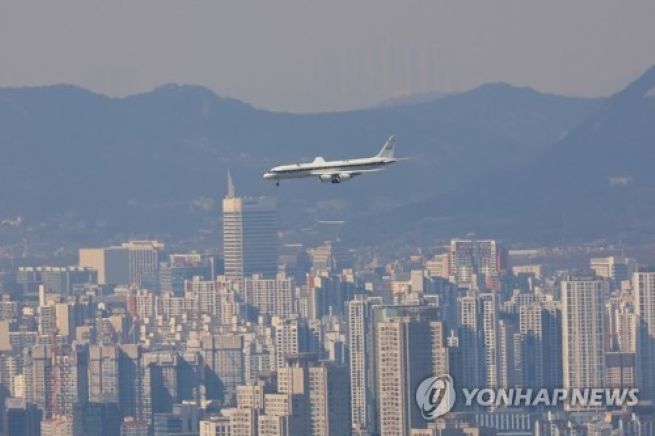
As part of the “Asia Air Quality Joint Study,” NASA’s research aircraft DC-8, equipped with air quality monitoring instruments, flies over downtown Seoul on February 26 last year. (Yonhap)
SEOUL, Oct. 9 (Korea Bizwire) — More than half of South Korea’s fine dust pollution during the winter months comes from China, according to new government data underscoring the persistent cross-border nature of the country’s air quality problem.
A report released Wednesday by the National Institute of Environmental Research (NIER) found that 55 percent of ultrafine particulate matter (PM2.5) detected in South Korea originated from China, while 29 percent was domestically generated. The study was based on the Asia Air Quality Joint Study (ASIA-AQ) — a large-scale collaborative investigation conducted in early 2024 by NIER, NASA, and international experts using seven atmospheric transport models.
The report concluded that China’s influence on Korea’s air pollution was particularly pronounced during heavy smog episodes. During periods of elevated PM2.5 concentration between March 3 and 8 last year, China’s contribution rose to as high as 71 percent, with the Beijing-Tianjin-Hebei region and central provinces such as Henan, Hubei, and Hunan cited as major sources.
Even during moderate pollution periods, such as from March 9 to 31, Chinese emissions accounted for about 60 percent of Korea’s fine dust levels — a finding researchers said illustrates the overwhelming external impact on Korean air quality.
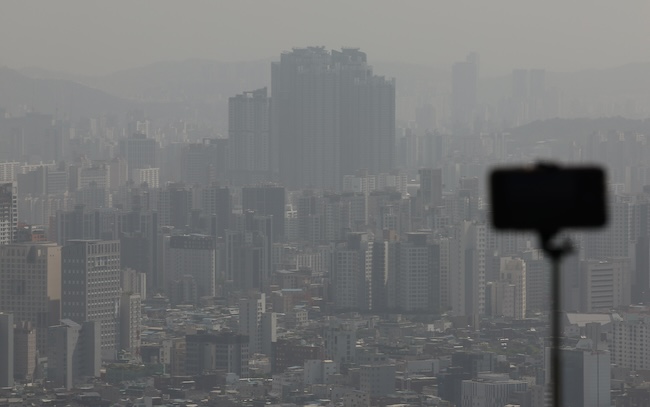
Fine dust (Image courtesy of Yonhap)
By contrast, domestically produced fine dust — generated from industrial emissions, vehicles, and other human activities — accounted for an average of 29 percent, ranging from 16 to 43 percent depending on weather and emission conditions. Only up to 21 percent of fine dust was attributed to other sources outside both countries, according to the report.
While the findings reaffirm the significance of transboundary pollution, both countries have seen improvements in recent years. South Korea’s annual average PM2.5 concentration dropped 40 percent to 15.6 micrograms per cubic meter in 2024 from 26 micrograms in 2016. China recorded a similar 36 percent decline over the same period, with its national average falling from 47 to 30 micrograms.
Environmental experts said the results highlight the need for sustained regional cooperation. “Despite improvements on both sides, cross-border pollution remains the dominant factor affecting Korea’s air quality,” the report said, calling for stronger joint monitoring and emission-reduction efforts between Seoul and Beijing.
M. H. Lee (mhlee@koreabizwire.com)