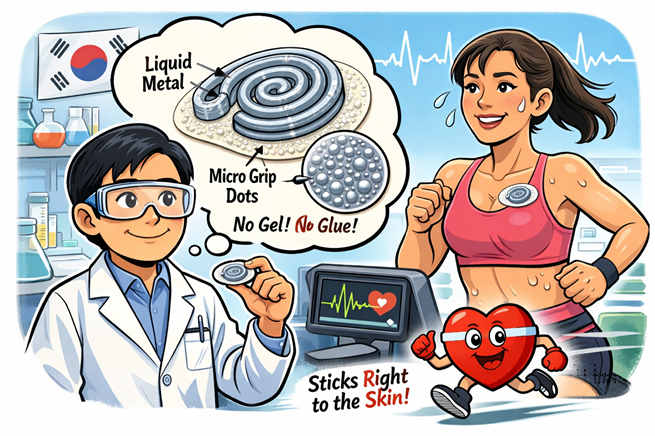
UNIST Team Unveils High-Precision Wearable ECG Sensor (Image supported by ChatGPT)
ULSAN, Feb. 10 (Korea Bizwire) — South Korean researchers have developed a wearable electrocardiogram patch that adheres to the skin without gels or adhesives, offering more precise heart monitoring even during vigorous movement.
The breakthrough, announced Monday by the Ulsan National Institute of Science and Technology (UNIST), relies on a microstructured combination of liquid metal and elastic silicone.
The research team, led by Prof. Jeong Hun-ui of the mechanical engineering department, designed a flexible electrode system that can directly capture cardiac signals without the conductive gels typically required in commercial patches.
At the core of the device are microscopic liquid metal channels, each about 20 micrometers wide, coiled like a snail shell. The lower section of the channels is open, allowing heart signals to pass directly into the liquid metal electrode when placed on the skin.
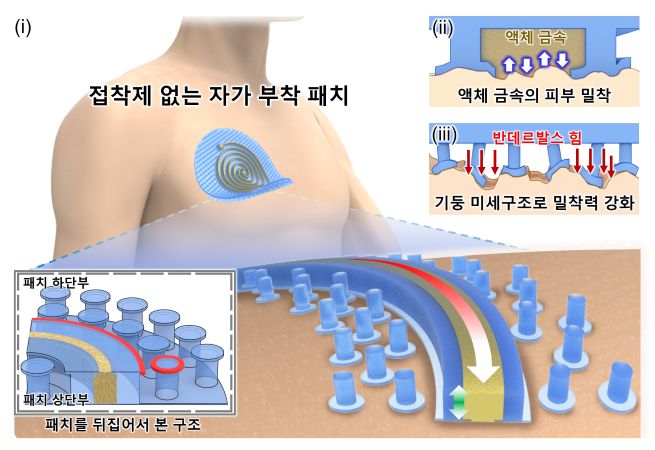
The microstructure of the electrocardiogram patch developed by the research team. (Image courtesy of the Ulsan National Institute of Science and Technology)
To prevent leakage of the liquid metal under pressure, the team engineered an inward-curving horizontal ridge along the base of the channels. The patch surface is also covered with microscopic protrusions — 28 micrometers in diameter and 20 micrometers in height — that function as natural adhesion structures, eliminating the need for glue.
In laboratory tests, the new patch demonstrated electrode resistance more than five times lower than that of conventional commercial ECG patches. It was also able to detect smaller electrical signals and maintained roughly twice the signal accuracy of existing products during activities such as walking and running.
Professor Jeong said the technology could serve as a foundational platform for next-generation wearable systems, including long-term health monitoring for patients with sensitive skin and high-precision human-machine interfaces.
The research was published last month as a cover paper in the international journal Advanced Science, underscoring its potential significance in the field of wearable biomedical devices.
Kevin Lee (kevinlee@koreabizwire.com)