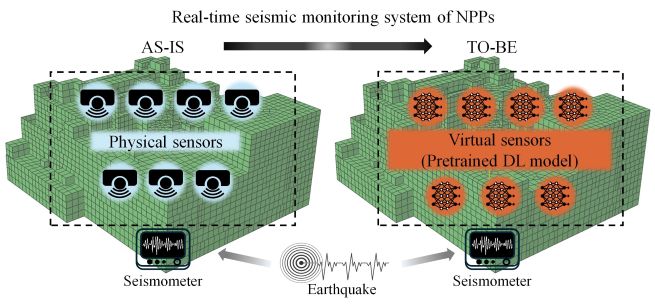
Existing sensor-based monitoring technology (left) and technology using AI-powered virtual sensors. (Image provided by UNIST)
ULSAN, Oct. 1 (Korea Bizwire) — South Korean researchers have unveiled an artificial intelligence system capable of predicting earthquake damage across nuclear power plant facilities using data from a single sensor, potentially transforming safety protocols in one of the most restricted environments for monitoring.
A team led by Professor Lee Young-joo of the Ulsan National Institute of Science and Technology (UNIST) and Dr. Lee Jae-bum of the Korea Research Institute of Standards and Science announced the breakthrough on Tuesday.
Their AI model can estimate vibration responses at 139 different points within a nuclear plant’s auxiliary building in just 0.07 seconds, based on seismic data collected by a single device.
The system analyzes how facilities shake — their “acceleration response” — as seismic waves pass through. By mapping these responses, it can identify which sections of a plant require urgent inspection, replacing the need for hundreds of physical sensors.
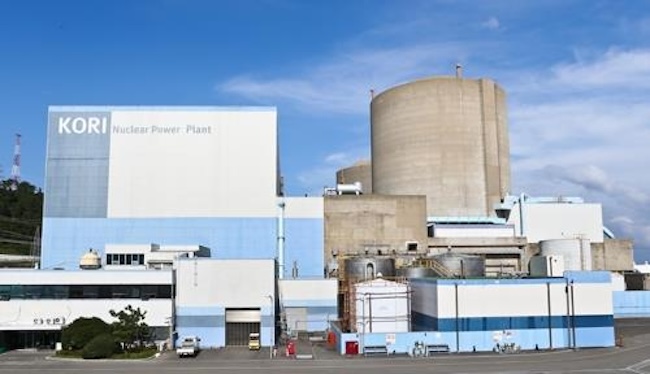
This file photo, provided by the Korea Hydro & Nuclear Power Co. on Oct. 29, 2019, shows the now-retired Kori-1 nuclear reactor located in the southeastern port city of Busan. (Image courtesy of Yonhap)
Tests showed remarkable precision: in noiseless conditions, prediction errors were as low as 0.44 to 0.59 percent. Even under simulated noise of 10 decibels, errors remained around 4 percent. The model also held up under strong-motion scenarios, meeting safety thresholds set for nuclear plants in both Korea and the United States.
Installing and maintaining large networks of seismic sensors in radiation-controlled zones has long been a costly and difficult task. The researchers say their AI-based method could fundamentally ease those burdens.
The findings were published in the international journal Computer-Aided Civil and Infrastructure Engineering on August 1. Lead researcher Jin-gu Lee received an honorable mention at the 28th International Conference on Structural Mechanics in Reactor Technology (SMiRT) for the work.
Kevin Lee (kevinlee@koreabizwire.com)