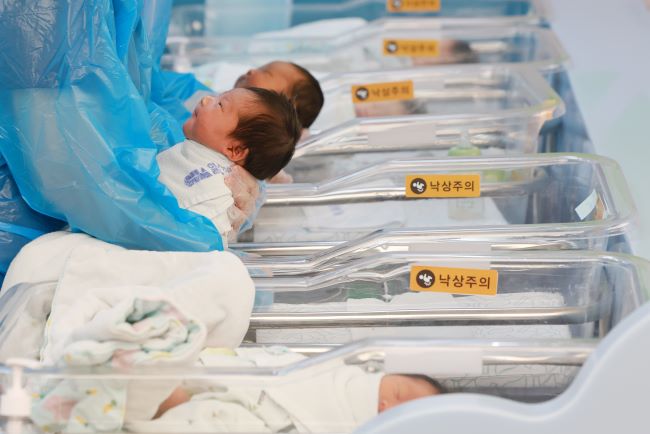
Health Insurance Review and Assessment Service reveals that one-third of South Korea’s districts are experiencing a severe decline in birth rates. (Image courtesy of Yonhap)
SEOUL, Aug.12 (Korea Bizwire) — A recent report by the Health Insurance Review and Assessment Service reveals that one-third of South Korea’s districts are experiencing a severe decline in birth rates, with fewer than 10 births per year.
This troubling trend is largely attributed to the nation’s aging population, declining fertility rates, and the absence of local birthing facilities, leading many expectant mothers to seek medical services in nearby areas.
In 2024, a total of 237,484 births were reported across hospitals, clinics, general hospitals, and midwifery centers nationwide. However, of the 251 districts (si, gun, gu), 97 regions, or 38.6%, recorded fewer than 10 births annually.
These areas include both rural and urban regions, such as the cities of Gwangju, Danyang, and Mungyeong, and smaller districts like Cheorwon, Jincheon, and Gangjin.
Although the national birth rate has been declining for years, with many regions experiencing limited or no local delivery services, the government has struggled to sustain support for medical facilities in such areas.
Some critics argue that with the low number of births, it is impractical to maintain birthing facilities in every district.
Professor Yoon Seok-jun of Korea University School of Medicine noted, “Even with government support, it is difficult to sustain hospitals in low-birth areas. It may be more efficient to strengthen emergency transport systems and improve connectivity between medical networks to ensure safe delivery options.”
The government’s efforts to support vulnerable birthing regions have faced challenges, but experts believe enhancing inter-regional collaboration and transportation systems will be more effective than attempting to provide facilities in every district.
M. H. Lee (mhlee@koreabizwire.com)