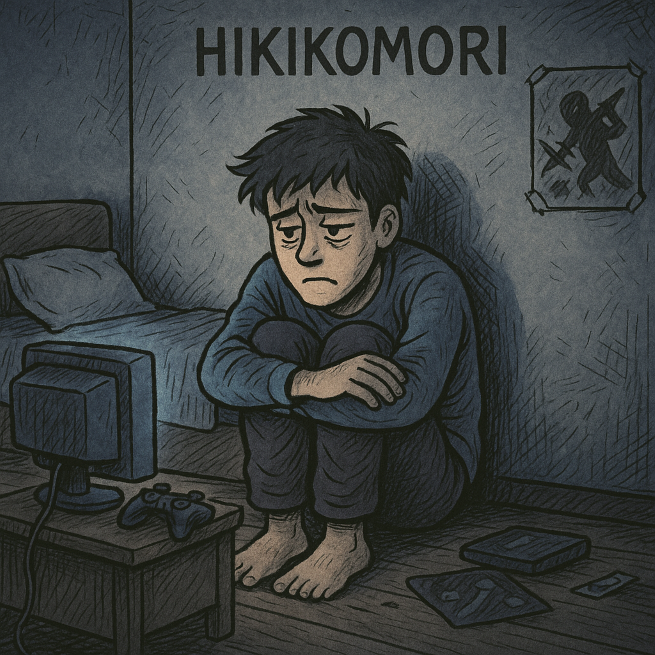
Jobless, Isolated, and Angry: The Rise of South Korea’s Disconnected Youth (Image supported by ChatGPT)
SEOUL, May 9 (Korea Bizwire) — An increasing number of young South Koreans are withdrawing from society and confining themselves indoors, emerging only at night — a pattern that is raising alarm among mental health professionals, law enforcement, and social policy experts.
According to a March 2025 report by the Office for Government Policy Coordination, 5.2% of South Koreans aged 19 to 34 now identify as socially withdrawn or reclusive, more than double the 2.4% reported in 2023. The findings are based on a nationwide survey of 15,098 households.
Referred to informally by police as “snail youths” — likening them to nocturnal creatures that stay hidden by day — these individuals often sever ties with family and friends and, in extreme cases, become sources or victims of domestic violence.
“We’ve received reports from parents begging us to intervene after their reclusive sons became verbally or physically abusive,” one police officer said on Wednesday. “Some of them only emerge from their rooms after 11 p.m., behaving aggressively within the home.”
Authorities are also seeing reverse cases, where reclusive youths report their own parents to the police. In one incident from October 2024, a man in his twenties living in Seoul’s Seongbuk District filed multiple complaints against his mother after she urged him to go outside and socialize, prompting intervention from the police to separate the two.
Experts warn that the phenomenon extends beyond simple familial strife. In recent months, there have been disturbing reports of isolated youths roaming the streets at night armed with weapons.
Police suggest some individuals lose their grip on reality after prolonged exposure to violent video games or online content consumed in isolation.
Silent Crisis: Surge in Socially Withdrawn Youths Prompts Calls for Mental Health Reform
“This is not just a private family matter — it’s becoming a public safety and social integration issue,” said Jeong Jae-hoon, a professor of social welfare at Seoul Women’s University. “The combination of social disconnection and job market exclusion is deepening their marginalization.”
Jeong called for a broader public response, including expanded mental health services and new centers focused specifically on preventing social isolation among youth. “Existing mental health welfare centers are not enough,” he said.
“The Ministry of Health and Welfare and local governments must allocate targeted funding and implement policies to re-engage this growing population.”
As South Korea grapples with rising youth isolation amid social and economic pressures, experts say now is the time to build stronger support systems — before more cases turn violent or slip through the cracks entirely.
Ashley Song (ashley@koreabizwire.com)