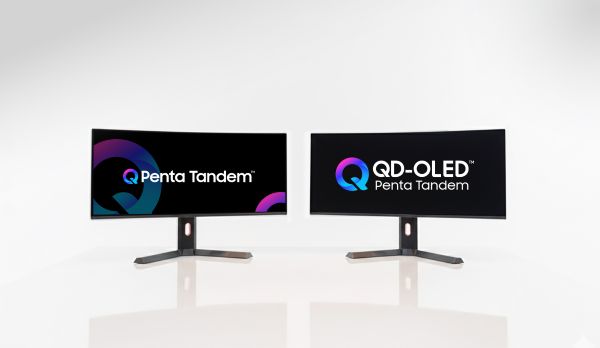
Samsung Display launches its premium technology brand “QD-OLED Penta Tandem.” (Photo courtesy of Samsung Display)
SEOUL, Feb. 12 (Korea Bizwire) — Samsung Display on Thursday introduced a new five-layer QD-OLED architecture branded “Penta Tandem,” a technological upgrade aimed at reinforcing its dominance in the premium television and monitor market.
The innovation increases the number of stacked blue OLED emission layers — the light source in QD-OLED panels — from four to five. The additional layer significantly enhances luminous efficiency, allowing displays to achieve higher brightness with the same power consumption or maintain brightness while reducing energy use.
Compared with last year’s four-layer QD-OLED panels, the new five-layer structure improves light efficiency by roughly 30 percent and doubles panel lifespan, the company said. Peak brightness reaches up to 4,500 nits for television panels and 1,300 nits for monitors under a 3 percent on-pixel ratio standard — levels that Samsung says rank among the highest in the industry.
As display manufacturers push for ever-higher pixel density and sharper resolution, organic material stacking has emerged as a critical engineering challenge. Smaller pixels reduce emission area, requiring more efficient energy distribution within the organic layers.
Samsung’s latest structure addresses that constraint, the company said, by optimizing material composition and layering techniques developed over five years of QD-OLED mass production.
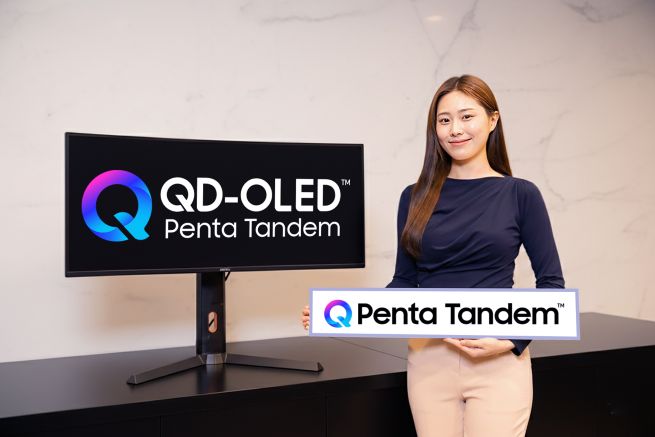
Samsung Display launches its premium technology brand “QD-OLED Penta Tandem.” (Photo courtesy of Samsung Display)
Panels using the Penta Tandem technology are also capable of supporting VESA’s DisplayHDR True Black 500 certification. A recently launched 31.5-inch UHD monitor equipped with the new panel is currently the only product in its size category to receive the certification.
Samsung Display plans to expand the technology across its entire product portfolio this year. After introducing 27-inch UHD panels last year and 31.5-inch UHD and 34-inch WQHD panels earlier this year, the company intends to roll out a 49-inch dual-QHD (5120×1440) model in the second half. The technology has already been adopted in flagship OLED television models by major clients.
“The organic material stacking process is not simply about adding more layers,” said Jung Yong-wook, head of strategic marketing for Samsung Display’s large display division. “It requires precise expertise in selecting materials, thickness and combinations. Penta Tandem reflects five years of accumulated QD-OLED production experience and offers customers the clearest proof of premium performance.”
With demand for high-brightness, high-contrast displays intensifying amid the rise of gaming, content creation and advanced computing, Samsung’s latest move underscores a broader industry race to push OLED technology to its physical limits.