
Google’s Bid for South Korean High-Precision Maps Sparks National Security Concerns (Image courtesy of Google)
SEOUL, August 1 (Korea Bizwire) — As South Korea prepares to review Google’s request to export high-resolution local mapping data next month, government officials are signaling that national security—not trade relations—will remain the key lens through which the issue is assessed.
Despite recent speculation that the matter might surface in the context of U.S.-Korea trade negotiations, officials confirmed that Google’s export request was not included in the latest round of tariff talks between the two nations. The omission suggests Seoul’s longstanding concerns over data security continue to outweigh economic pressure.
Google is seeking permission to transfer 1:5,000 scale high-precision mapping data to overseas servers—its third attempt since 2007. The South Korean government has previously rejected similar requests, citing national defense concerns. In 2016, it proposed that Google store the data domestically, a condition the tech giant declined.
Anticipation had mounted in recent months that the sensitive issue might be revisited amid broader trade friction, particularly as the U.S. has criticized South Korea’s digital regulations—such as its platform rules—as protectionist.
However, the recently concluded U.S.-Korea tariff agreement excluded any commitments related to digital data, prompting cautious optimism among domestic platform providers.
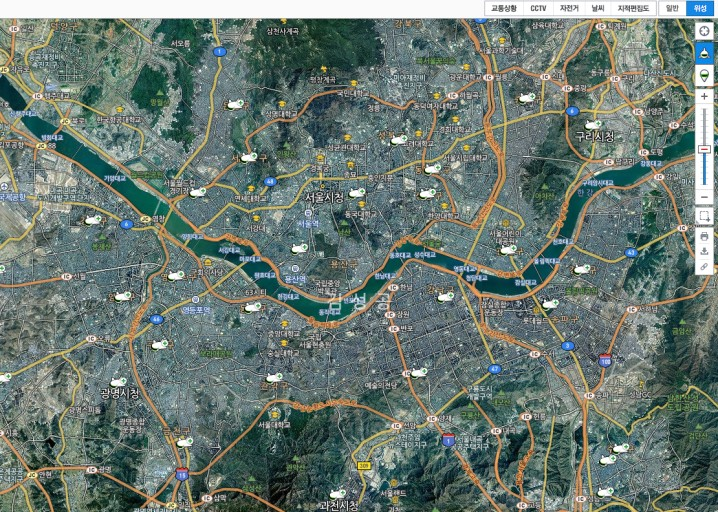
A highly accurate high-definition map view from Naver Map. (Image source: Naver Map)
At a press briefing following the tariff deal, Presidential Policy Chief Kim Yong-beom stated that the mapping issue had been “defended” by the Korean side, emphasizing there had been “no additional concessions.”
He reiterated that the matter falls under national security, not trade, and hinted that it could be addressed during an upcoming summit between President Lee Jae-myung and U.S. President Donald Trump.
A cross-ministerial panel—comprising the Land Ministry, Science Ministry, Foreign Ministry, National Intelligence Service, and others—is scheduled to convene on August 11 to make a final determination on Google’s request.
Several top cabinet members have voiced skepticism over allowing the data export. Land Minister Kim Yoon-duk said during his confirmation hearing that while economic considerations matter, “national defense and public safety must come first.”
Culture Minister Choi Hwi-young, who previously expressed support for open data during his time at tech firm Yanolja, has since taken a more cautious stance, citing national and industrial security.
Science and ICT Minister Bae Kyung-hoon and Defense Minister Ahn Kyu-baek have also reiterated their reservations. Ahn, in particular, has a legislative track record of opposing the export of sensitive geographic information, having once proposed a law restricting such data to maps with a scale no greater than 1:25,000.
With inter-agency consensus leaning toward caution and the issue increasingly framed as a strategic rather than commercial matter, South Korea appears poised to continue its defensive posture—at least for now. Whether the upcoming summit alters that calculus remains to be seen.
Kevin Lee (kevinlee@koreabizwire.com)