
Lee Jae-myung stages economic recovery performance amid campaign push. (Image courtesy of Yonhap)
SEOUL, July 3 (Korea Bizwire) — South Korea’s National Assembly on Thursday passed a revised Commercial Act aimed at strengthening minority shareholder rights, a move welcomed by financial markets as a potential catalyst for resolving the longstanding “Korea Discount” that has weighed on domestic stock valuations.
The legislation, which had previously been vetoed under the prior administration, includes a key reform to expand the so-called “3% rule” that limits voting rights of controlling shareholders when appointing audit committee members.
This revision applies the cap not only to outside directors but also to internal directors, significantly curbing the influence of controlling stakeholders and enhancing corporate governance.
President Lee Jae-myung, who campaigned on improving capital market transparency and promoting stocks as an alternative investment to real estate, reaffirmed his commitment during a press conference marking his first month in office.
“We will usher in the KOSPI 5,000 era through capital market reform,” he said, noting that recent reforms and efforts to curb stock market manipulation were beginning to reflect positively in investor sentiment.
Market Analysts See Revaluation Potential
Analysts view the reform as a crucial first step in improving shareholder protections and lowering governance risk. Hana Securities strategist Kim Doo-eon described the expanded 3% rule as “a signal flare” marking the beginning of the end for the Korea Discount.
Mirae Asset Securities noted that the Korean stock market’s historically low price-to-book ratio (PBR) was the result of weak shareholder return policies and high governance risk. It estimated that the current reforms could justify a 10% to 20% re-rating in valuation, particularly as global investors become more sensitive to governance quality.
“Reducing governance risk doesn’t just lower capital costs,” Mirae said. “It also improves board accountability and transparency, potentially driving long-term improvements in return on equity.”
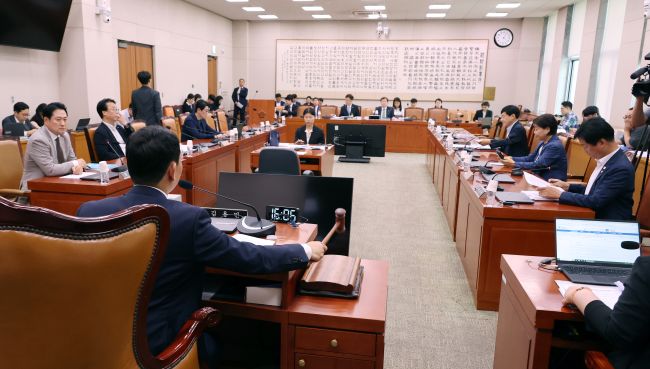
Ruling and opposition parties reach consensus on commercial act amendment. (Image courtesy of Yonhap)
Reform Boosts Momentum for KOSPI Rally
The legislative breakthrough comes amid cautious optimism in the market. The KOSPI recently hit a 2025 high of 3,130 before entering a consolidation phase, pressured by concerns over U.S. tariff policy and upcoming earnings reports.
But the reform could reignite momentum. Hana Securities projected the KOSPI could climb as high as 3,710, applying a historical price-to-earnings ratio of 14.2, supported by renewed foreign capital inflows.

This move is welcomed by financial markets as a potential catalyst for resolving the longstanding “Korea Discount” that has weighed on domestic stock valuations. (Image supported by ChatGPT)
Critics Note Gaps in Reform, Call for Continued Action
Despite the positive reception, some critics pointed to the exclusion of a mandatory cumulative voting system, a mechanism that would allow minority shareholders to concentrate votes on preferred board candidates. This provision had been expected but was dropped due to partisan disagreement.
NH Investment & Securities analyst Kim Jong-young noted that omitting cumulative voting could dampen the full impact of the reform. “This was a missed opportunity to further empower minority shareholders,” he said.
However, there is room for optimism: further legislative discussions, including potential reforms to dividend tax policy, inheritance tax, and mandatory treasury share retirement, are underway. Kim suggested that any near-term correction in governance reform-related stocks could offer a buying opportunity.
As Korea moves to align its corporate governance with global standards, investors and policymakers alike are watching closely to see whether this marks a turning point for the undervalued Korean equity market.
M. H. Lee (mhlee@koreabizwire.com)