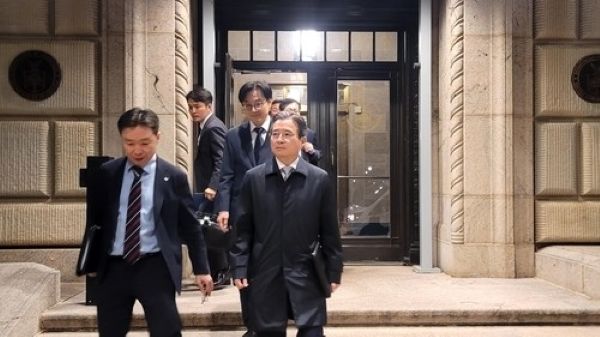
Kim Yong-beom (R), presidential chief of staff for policy, and Industry Minister Kim Jung-kwan (C) walk out of the Commerce Department in Washington on Oct. 16, 2025. (Yonhap)
WASHINGTON, Oct. 17 (Korea Bizwire) – South Korea’s top economic policymakers gathered in Washington this week, pressing to finalize a landmark trade agreement that could redefine the industrial and strategic alignment between Seoul and Washington.
Industry Minister Kim Jung-kwan and U.S. Commerce Secretary Howard Lutnick met Thursday for what officials described as an “in-depth” two-hour discussion on the implementation of Korea’s $350 billion investment pledge under a framework deal reached in July.
The meeting was part of an intensive diplomatic push by Seoul, which dispatched several of its most senior economic figures — including Finance Minister Koo Yun-cheol, Presidential Policy Chief Kim Yong-beom, and Trade Minister Yeo Han-koo — to the U.S. capital to accelerate progress on what both sides have called a “transformational” economic partnership.
“We had sufficient talks for two hours,” Kim Yong-beom told reporters as he and the industry minister exited the Commerce Department, declining to comment on whether tangible progress had been made.
While no details emerged from the talks, both sides are under pressure to conclude negotiations within weeks, with a summit between South Korean President Lee Jae Myung and U.S. President Donald Trump expected to take place during the Asia-Pacific Economic Cooperation (APEC) summit in Korea later this month.
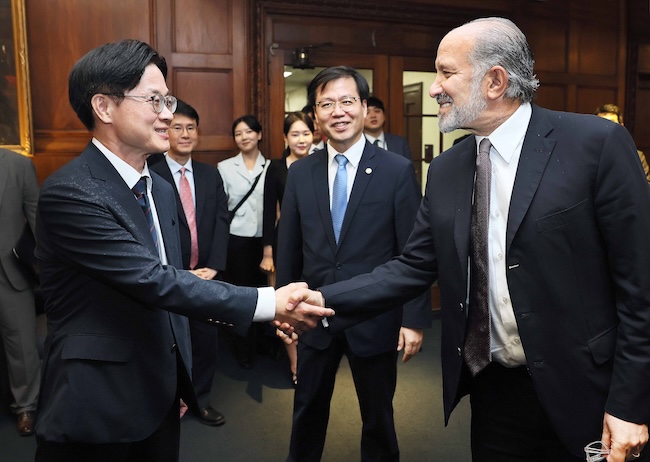
This photo, provided by the Ministry of Trade, Industry and Energy, shows Industry Minister Kim Jung-kwan (L), Trade Minister Yeo Han-koo (C) and U.S. Commerce Secretary Howard Lutnick during their meeting on trade issues in Washington on July 24, 2025. (Image courtesy of Yonhap)
Bridging Gaps in a Landmark Pact
The framework agreement, struck in late July, commits Seoul to invest $350 billion in U.S. industries, in return for Washington’s reduction of a “reciprocal” tariff on Korean autos from 25 percent to 15 percent — a significant concession in the fiercely competitive automotive sector.
Yet key questions remain unresolved, particularly how the investment package will be financed and which sectors will qualify for tariff relief. The delay has fueled speculation that political considerations — including the upcoming U.S. election cycle — may shape the pace of negotiations.
Seoul officials, however, described the latest talks as the most “earnest and constructive” to date. “We are at a juncture when the two countries are engaging in negotiations in the most sincere atmosphere,” Kim Yong-beom said upon arriving at Dulles International Airport earlier Thursday. “We will do our utmost to ensure that the outcome serves Korea’s national interest.”
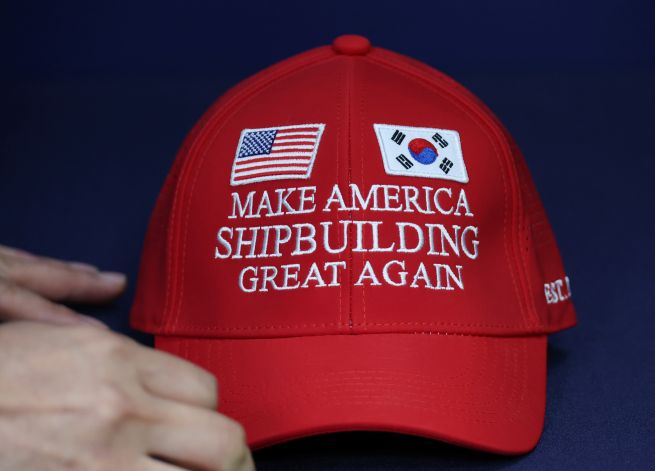
The presidential office unveiled the “MASGA” (Make American Shipbuilding Great Again) cap on August 3. “MASGA” is a slogan created by the Ministry of Trade, Industry, and Energy to succinctly convey the shipbuilding cooperation details in the recent U.S.-South Korea tariff negotiations. The South Korean negotiation team prepared this cap along with large panels for the occasion. (Yonhap)
Shipbuilding Ties Deepen Under MASGA
Earlier in the day, Kim and other senior officials met with Russell Vought, director of the U.S. Office of Management and Budget, to discuss cooperation on shipbuilding as part of the “Make American Shipbuilding Great Again” (MASGA) initiative — a project embedded within the broader trade framework.
The MASGA project envisions the construction of new U.S. shipyards, the training of skilled workers, and the rebuilding of supply chains, with South Korean shipbuilders such as HD Hyundai and Hanwha Ocean expected to play pivotal roles.
“We had constructive talks on various matters related to the MASGA project,” Industry Minister Kim said. “We discussed what concrete projects can be carried out going forward.”
The OMB, though not a direct party to the trade negotiations, oversees U.S. industrial investment programs, making it a key player in coordinating shipbuilding and defense-related infrastructure spending.
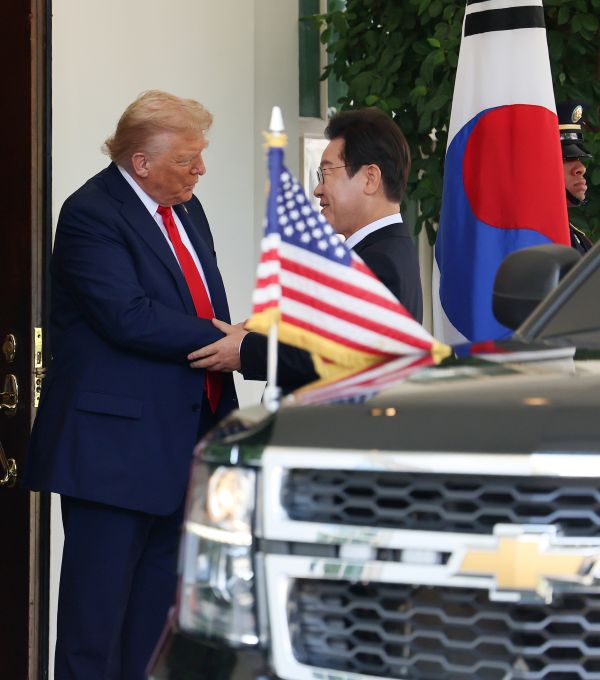
South Korean President Lee Jae Myung (R) is greeted by U.S. President Donald Trump ahead of their talks at the White House in Washington on Aug. 25, 2025. (Yonhap)
A Strategic Convergence
The talks come at a time when the Biden administration’s successor has sought to reshape America’s industrial alliances — a policy that President Trump has continued under his “America First Rebuild” initiative. For Seoul, deeper integration with U.S. industrial policy offers both opportunity and risk: access to the vast U.S. market, but also heightened exposure to Washington’s strategic calculations, particularly as tensions with China persist.
U.S. Treasury Secretary Scott Bessent said earlier this week that he expects a deal “within 10 days,” a comment that Seoul officials interpreted as a positive signal. “If the U.S. expects a result within 10 days, that appears to represent its interim assessment of the negotiations,” Kim said. “We hope that the U.S. will reflect more of our position as much as it can.”
While optimism runs high, Seoul’s delegation insists it will not rush an agreement at the expense of its core interests. “Our position is to stay principled, not hasty,” Kim said.
The outcome of the talks could mark a turning point for South Korea’s industrial diplomacy — not only redefining trade and investment flows but also cementing the country’s role as Washington’s most critical partner in reshaping the global manufacturing landscape.
M. H. Lee (mhlee@koreabizwire.com)