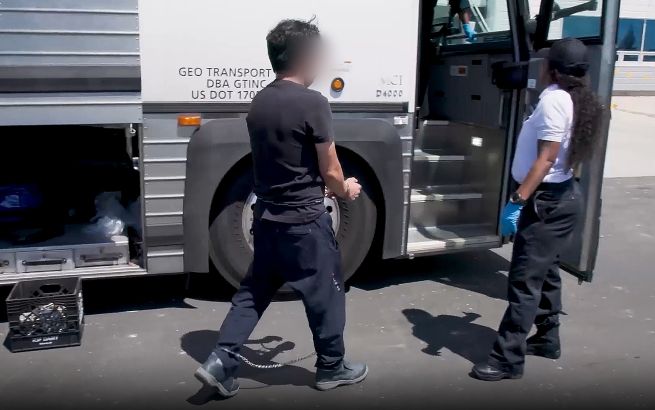
U.S. immigration authorities released on their website video footage of the Sept. 4 (local time) raid targeting undocumented workers and illegal employment at the Hyundai Motor Group–LG Energy Solution joint battery plant construction site in Georgia. (Image source: screenshot from video posted on the U.S. Immigration and Customs Enforcement website)
SAVANNAH, Ga., Sept. 8 (Korea Bizwire) — The workday had barely begun when phones began buzzing in unison at Hyundai Motor Group and LG Energy Solution’s sprawling battery plant construction site in Georgia. A text message appeared: stop work immediately.
Within minutes, federal agents from Immigration and Customs Enforcement and Homeland Security Investigations swept across the site. By the end of the Sept. 4 raid, 475 workers were in custody. More than 300 of them were Korean.
For one Korean technician, the experience was bewildering. He told the BBC he had been working legally but watched colleagues hustled away without their phones, unable to contact their families. “The calls kept coming, but the phones were locked inside the office,” he said. “They had to leave everything behind.”
The raid, though sudden, was not wholly unexpected. Under President Donald Trump’s revived “America First” agenda, immigration enforcement has intensified, with undocumented labor a particular target. Yet the worker’s words carried a sting of resignation: “It was shocking, but not surprising.”
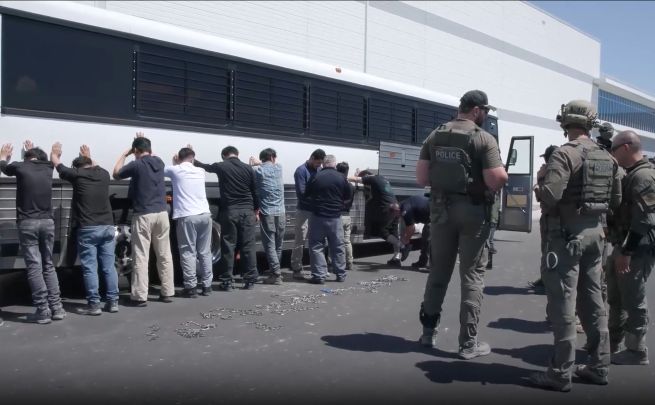
U.S. immigration authorities released footage on their website of a September 4 (local time) raid targeting undocumented workers at the Hyundai Motor Group–LG Energy Solution joint battery plant construction site in Georgia. (Image source: website video capture)
The battery plant, a centerpiece of Korean corporate investment in the American South, had energized Georgia’s Korean community. Restaurants and small businesses thrived on the influx of workers. Now the mood has shifted to fear. “Even those with green cards or citizenship are anxious,” said Ruby Gould, president of the Korean Association of Savannah. “The whole community is in shock.”
The political optics are complicated. The Trump administration has loudly encouraged Korean conglomerates to pour billions into U.S. factories critical to electric vehicle supply chains. But its visa system, critics note, remains cumbersome, leaving companies desperate to fill specialized roles in construction and equipment installation.
“This work is highly technical,” the Korean employee explained. “That’s why experts were brought from Korea. But companies now see the risk. Future projects will take longer.”
American media outlets have been scathing. The New York Times called the administration’s posture contradictory: wooing Asian investment while handcuffing the workers required to realize it. Tammy Overby, a former U.S. Chamber of Commerce vice president for Asia, said the message reverberated across the Pacific. “One friend told me, ‘They want our money, but not us.’”
For now, the battery plant project remains on track, but the aftershocks are profound. What was once a symbol of U.S.-Korea industrial partnership has become a case study in the collision between economic strategy and immigration politics — and a reminder of how easily optimism in a community can give way to fear.
M. H. Lee (mhlee@koreabizwire.com)