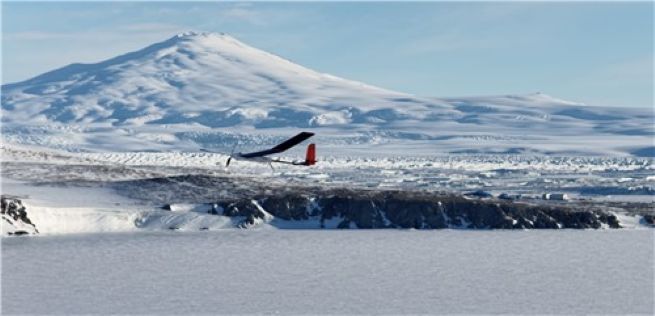
Small solar-powered unmanned aircraft developed by the Korea Aerospace University research team (Image courtesy of Korea Aerospace University)
GOYANG, Dec. 2 (Korea Bizwire) — Korea Aerospace University (KAU) announced Monday that its research team has successfully completed what it says is the world’s first solar-powered UAV flight test on the Antarctic continent, marking a milestone for autonomous aviation in extreme environments.
The test flights, conducted Nov. 8–17 near South Korea’s Jang Bogo Station with support from the Korea Polar Research Institute, deployed the university’s homegrown solar-powered unmanned aircraft, the KAU-SPUAV. Developed by professors Bae Jae-sung and Park Sang-hyuk, the aircraft previously set South Korea’s endurance record for solar UAVs in 2021, staying aloft for 56 hours and 33 minutes.
With a 3.3-meter wingspan and a maximum takeoff weight of 4 kilograms, the lightweight craft is designed for long-duration, low-altitude flight. Solar panels mounted along the wings recharge onboard batteries during daylight, allowing continuous operation without returning to the ground — a critical advantage for remote regions where access is limited.
Researchers said the Antarctic mission required seven months of preparation, given the continent’s harsh conditions and the need for highly reliable autonomous systems. The project was originally planned for 2020 but was postponed due to the pandemic.
The team reported that the UAV operated successfully under polar day conditions, demonstrating its ability to harness sufficient solar energy for 12 to 24 hours of sustained flight.
“The tests confirmed that long-endurance solar flight is achievable even in the unique environment of the polar regions,” the team said, adding that the results lay the groundwork for future applications in environmental monitoring, climate research, and polar logistics.
Kevin Lee (kevinlee@koreabizwire.com)