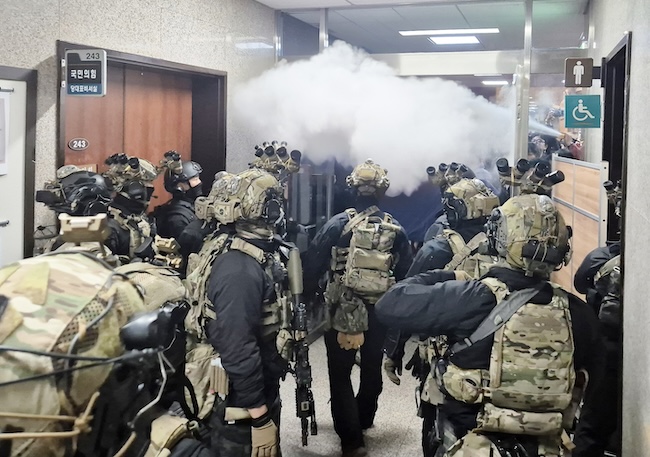
South Korea’s military is grappling with a crisis of morale among its younger service members, following their controversial deployment during President Yoon Suk Yeol’s now-lifted martial law declaration. (Image courtesy of Yonhap)
SEOUL, Dec. 6 (Korea Bizwire) – South Korea’s military is grappling with a crisis of morale among its younger service members, following their controversial deployment during President Yoon Suk Yeol’s now-lifted martial law declaration.
Dubbed the “MZ Martial Law Troops” for their composition of Millennial and Gen Z soldiers, many expressed disillusionment over being used in what they viewed as an unjust and politically motivated operation.
A Controversial Mission
In the early hours of December 4, approximately 280 armed troops were dispatched to the National Assembly under martial law orders. Though heavily armed, their actions were restrained, with physical force largely avoided despite breaking windows to enter the Assembly building.
Soldiers refrained from confronting fleeing lawmakers or aggressively engaging protesting civilians, with some reportedly apologizing during their withdrawal.
According to military sources, some commanders even collected training rounds after the operation, highlighting the symbolic, rather than practical, nature of the deployment.
“These elite anti-terror units were sent into an unthinkable situation, with little understanding of the circumstances,” said an anonymous Army major, suggesting that many soldiers were reluctant to fully engage.
Generational and Institutional Tensions
For many younger soldiers, raised in a democratic South Korea, the experience of enforcing martial law—seen as a relic of the authoritarian era—was deeply unsettling. Retired Major Kim Se-jin, now a prominent YouTuber, recounted how numerous active-duty soldiers expressed feelings of betrayal and frustration.
“They told me, ‘We tried to do as little as possible, but we’re still being blamed for just being soldiers,’” Kim said.
The incident has also dealt a severe blow to the military’s reputation, according to Jin Hwal-min, a former Army Academy professor. “Generations of effort to shed the image of a military dictatorship have been undone in a single day,” Jin noted.
Calls for Accountability
While no collective rebellion has emerged among younger soldiers, there is growing pressure from within and outside the military for accountability. Critics argue that senior commanders who authorized the operation must take responsibility.
“Without a transparent investigation and changes in leadership, including public apologies, it will be impossible to restore trust in the military chain of command,” said a retired colonel affiliated with a national security think tank.
Moving Forward
Although Deputy Defense Minister Kim and a ministry spokesperson have issued public apologies, observers say these actions fall short of addressing the broader institutional damage.
As South Korea reckons with the fallout of the martial law crisis, its military must navigate the delicate task of rebuilding morale among its disheartened troops while preserving its integrity as a pillar of democracy.
M. H. Lee (mhlee@koreabizwire.com)