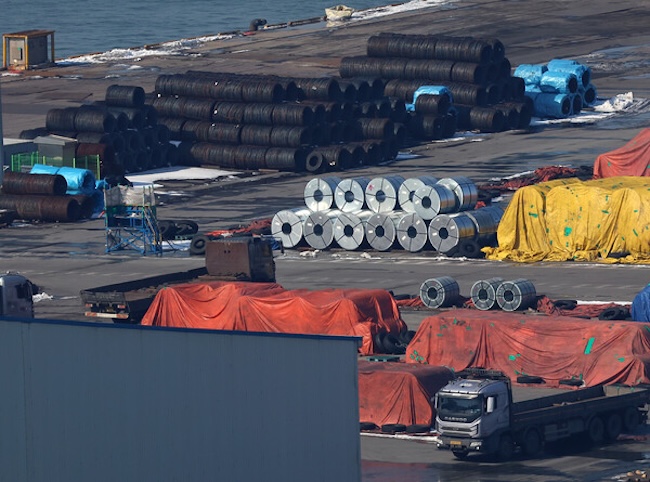
Steel products are piled up at a port in Pyeongtaek, about 65 kilometers south of Seoul, on Feb. 11, 2025. (Image courtesy of Yonhap)
SEOUL, June 4 (Korea Bizwire) — U.S. President Donald Trump signed a proclamation Tuesday raising tariffs on imported steel and aluminum from 25% to 50%, dramatically escalating trade tensions and sending shockwaves through South Korea’s embattled steel industry.
The move, viewed by many as the realization of a “steel curtain” around the U.S. market, erects a formidable barrier for South Korean exporters already reeling from sluggish global demand and rising competition from low-cost Chinese products. With domestic construction activity also in decline, industry leaders say the tariff hike could not have come at a worse time.
South Korea’s steel sector, the largest exporter of steel to the United States in 2024 with a 13.06% share, now faces steep losses. “A 50% tariff is not something even U.S.-based importers and manufacturers can absorb,” said one South Korean industry executive. “This appears to be a calculated move by Trump to gain leverage in trade negotiations.”
The tariff hike follows a temporary 25% tariff imposed in March 2025 and compounds its impact. According to the Korea Institute for Industrial Economics & Trade, South Korea’s steel exports to the U.S. fell 10.2% year-on-year in the first four months of 2025. In May, after the initial tariff took effect, exports plunged by 20.6%.
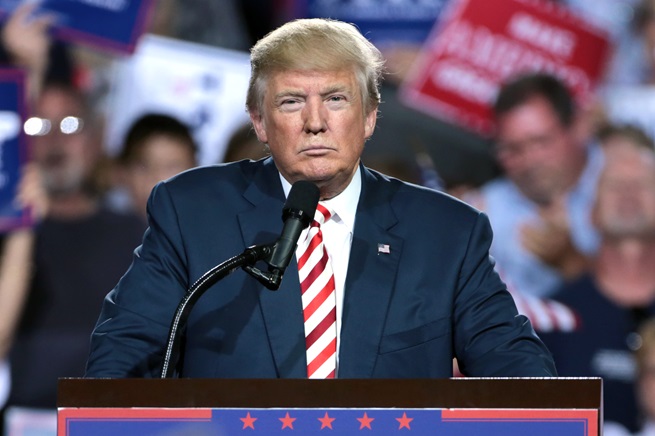
South Korean exports could drop between $5.3 billion and $44.8 billion if Trump implements his tariff policies and trading partners respond with equivalent measures against the United States. (Image courtesy of Wikimedia Commons)
Previously, exporters were able to price in a 25% tariff and still access the U.S. market, but a 50% rate makes American entry nearly untenable, industry insiders warn.
The broader fallout is expected to cascade across global markets. Analysts anticipate a surge in Chinese steel oversupply heading to other regions, while trade blocs such as the EU may respond with more protectionist measures. In fact, the EU has already strengthened safeguard quotas following the U.S. tariffs imposed earlier this year.
Observers believe the tariff hike also serves as a pressure tactic aimed at luring foreign firms to invest in U.S.-based manufacturing. Trump previewed the move during a speech at U.S. Steel on May 30, where he backed Nippon Steel’s $14 billion acquisition of the American steelmaker, contingent on the construction of a new domestic facility.
South Korea’s top steelmakers — POSCO Group and Hyundai Steel — are now preparing to counter Washington’s trade barriers through local investment. The two firms plan to jointly build an integrated steel mill in Louisiana by 2029, at an estimated cost of ₩8.5 trillion ($6.2 billion).
Still, with the plant years away from production, industry experts warn that survival in the short term will depend on strategic pivots — including a shift away from commodity steel toward high-value-added products.
“The government must also reinforce domestic safeguards against the influx of cheap foreign steel,” said Jang Sang-sik, head of international trade research at the Korea International Trade Association (KITA). “It’s time for both companies and policymakers to recalibrate quickly.”
As Trump’s second term redraws the map of global trade, South Korea’s export-driven steel industry finds itself in a high-stakes contest for market access — one that will likely define its competitiveness well into 2026 and beyond.
M. H. Lee (mhlee@koreabizwire.com)