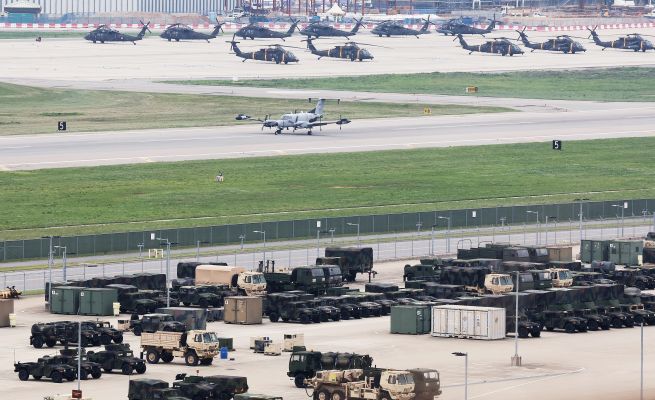
On May 23, the day U.S. media reported that the U.S. government is considering reducing its troop presence in South Korea, an RC-12X Guardrail reconnaissance aircraft is seen in motion at Camp Humphreys in Pyeongtaek, Gyeonggi Province. (Yonhap)
WASHINGTON, May 22 (Korea Bizwire) – The United States’ reported consideration of a U.S. Forces Korea (USFK) troop drawdown is raising eyebrows in South Korea as the reduction, if realized, could affect deterrence against a muscle-flexing North Korea and be construed as a sign of a diminished security commitment to South Korea.
President Donald Trump’s administration is weighing the idea of pulling out roughly 4,500 troops, part of the 28,500-strong USFK, and move them to other locations in the Indo-Pacific, including Guam, The Wall Street Journal reported Thursday, citing unnamed defense officials.
The move comes as the Pentagon is looking to rebalance and reapportion its military assets in the region to optimize deterrence against its geopolitical rival, China, amid Trump’s belief that South Korea, a “wealthy” ally, is not “reimbursing” the United States sufficiently for America’s “big-time” military protection of it.
The issue is expected to figure prominently as a key alliance topic for the next Seoul government that will be launched following the June 3 presidential election, an event triggered by the ouster of former conservative President Yoon Suk Yeol.
The idea of withdrawing around 16 percent of the USFK troops dovetails with the Trump administration’s pursuit of a reported approach whereby it prioritizes defending its homeland and bolstering deterrence against China’s potential invasion of Taiwan, while tasking regional allies to handle North Korea, Russia and other potential adversaries.
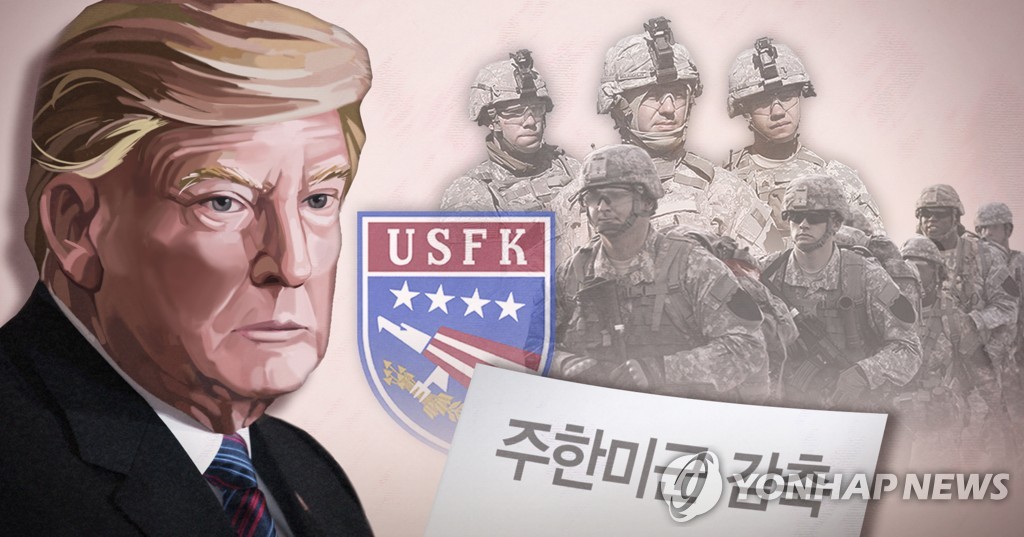
For some observers, the reduction option did not come as a big surprise as Trump’s earlier remarks on the USFK presence have raised that possibility, with his drive for the “America First” agenda fueling speculation over a potential scaling back of America’s costly overseas military involvement.
In April last year, U.S. magazine Time reported that Trump had suggested that the U.S. could pull out its troops in South Korea if the Asian ally does not pay more to support U.S. troops to deter threats from the “increasingly belligerent” North Korean regime. He noted U.S. troops in Korea are in a “precarious” position.
He has repeatedly revealed his perception that South Korea’s sharing of the cost for stationing the USFK is not enough.
“We pay for military over in Europe. We don’t get reimbursed by much … South Korea too,” Trump told reporters at the White House in April, responding to a question about whether he has any plans to reduce the number of American troops in Europe.
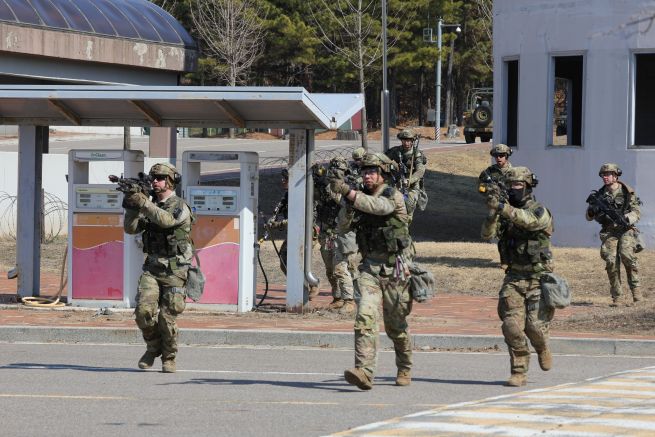
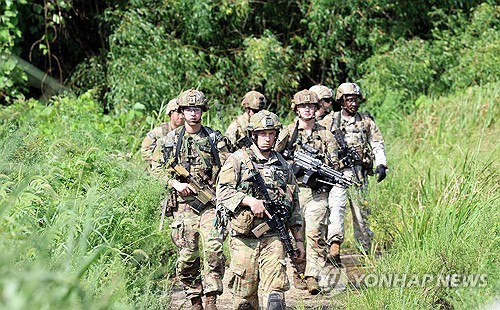
During the urban operations training for the South Korea-U.S. joint exercise “Freedom Shield” (FS) held on March 19 in Paju, Gyeonggi Province, a U.S. Forces Korea soldier charges toward a target. (Yonhap)
During a campaign period in October, Trump dubbed South Korea a “money machine” and said that if he had been in the White House, South Korea would be paying US$10 billion a year for the upkeep of USFK. Under a deal struck last year, Seoul is to pay 1.52 trillion won ($1.1 billion) next year, up from 1.4 trillion won this year.
For policymakers and other observers in Seoul, the reduction idea struck a worrisome note as it could be a foretaste of a brewing shift in the alliance that is being driven by Washington’s growing emphasis on countering Chinese threats.
In particular, the drawdown review called into question the prevailing idea that the U.S. government might not be able to unilaterally push for a troop cut due to the National Defense Authorization Act (NDAA) that calls for the maintenance of the current USFK troop strength.
“There have been no discussions at all between South Korea and the U.S. about the USFK troop withdrawal,” Seoul’s defense ministry said.
“The USFK, a core force of the South Korea-U.S. alliance, has contributed to peace and stability on the Korean Peninsula and in the region by working together with our military to maintain a robust combined defense posture and by deterring North Korea’s aggression and provocations,” it added.
Secretary of Defense Pete Hegseth has recently tasked Under Secretary of Defense for Policy Elbridge Colby to craft the 2025 National Defense Strategy (NDS) under a directive to prioritize deterring Chinese threats and raising burden sharing with allies. He directed that a final NDS draft be provided to him no later than Aug. 31.
The ongoing NDS work has raised the prospect of the U.S. seeking greater “strategic flexibility” of USFK forces to undertake expeditionary operations outside the Korean Peninsula in what could be a move signaling a shift in the USFK mission, role and force makeup.
During an interview with Yonhap News Agency in May, Colby advocated for a USFK overhaul to have it focus more on handling Chinese threats rather than “being held hostage” to dealing with the North Korean security quandary.
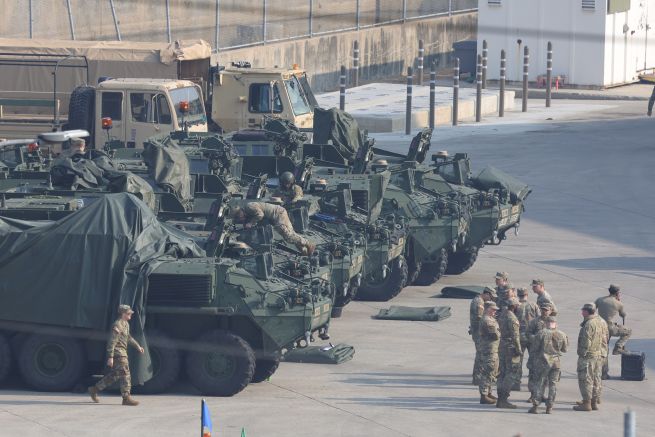
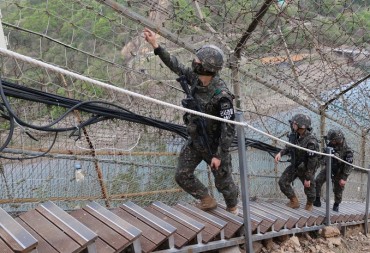
U.S. Forces Korea troops alongside a Stryker armored vehicle. (Yonhap)
Bruce Bennett warned that the troop reduction, if realized, could send an undesirable signal to both South and North Korea.
“I do think that this is not a great signal to be sending. It’s saying that we perceive that Korea is not all that important,” he said.
“Where can you put forces other than Korea that are as close as you can get to China? Having forces in Korea is ideal not just for dealing with North Korea but for dealing with China. To pull them out of Korea is really a bad idea from an overall U.S. perspective,” he added.
North Korea may view the potential reduction as a sign of “friction” in the alliance, Bennett pointed out.
“I think North Korea is potentially going to feel after the (presidential) election that there are various ways that it could undermine the alliance and start to increase its provocations in order to move in that direction,” he said.
The scholar also warned the U.S. government against considering pulling out key U.S. assets, such as Air Force assets, the air and missile defense element, and logistics, from Korea, as he highlighted their critical utility in the event of China-related contingencies.
“These are three critical things that would really be unwise to reduce,” he said.
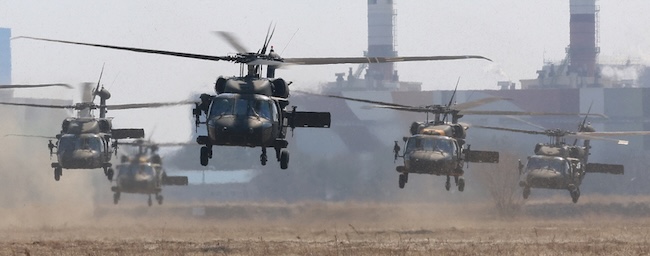
UH-60 Black Hawk helicopters fly in formation in combined drills with U.S. troops at a training range in Incheon, just west of Seoul, on March 19, 2025. (Image courtesy of Yonhap)
During a Senate hearing last month, U.S. Indo-Pacific Command Commander Adm. Samuel Paparo Jr. and USFK Commander Gen. Xavier Brunson presented negative views about the idea of a USFK troop drawdown.
Paparo warned the withdrawal or reduction of American troops from Korea would raise a “higher” likelihood of a North Korean invasion, while Brunson stressed that a troop reduction would be “problematic.”
“With the loss of the force on the Korean Peninsula, there’s a higher probability that (North Korea) would invade,” Paparo said.
Brunson affirmed the importance of maintaining USFK troops.
“What we do provide there is the potential to impose costs in the East Sea to Russia, the potential to impose costs in the West Sea to China, and to continue to deter against North Korea, as it currently stands,” Brunson said.
“I’m trying to focus right now on the capabilities necessary to do all those things that we might participate routinely in the campaign … which is to prepare, deter and then prevail in conflict should it come. But the forces in Korea play an important role. In over 75 years, they’ve done the same.”
In 2004, Seoul and Washington agreed to curtail the USFK troop number from the then 35,000 down to 25,000 under a U.S. strategy for “strategic mobility,” a concept that took on greater importance as the U.S. was coping with threats from terrorists and non-state actors whose locations were difficult to identify.
But during a summit in 2008, the allies agreed to keep the troop number at the current USFK level of 28,500.
(Yonhap)