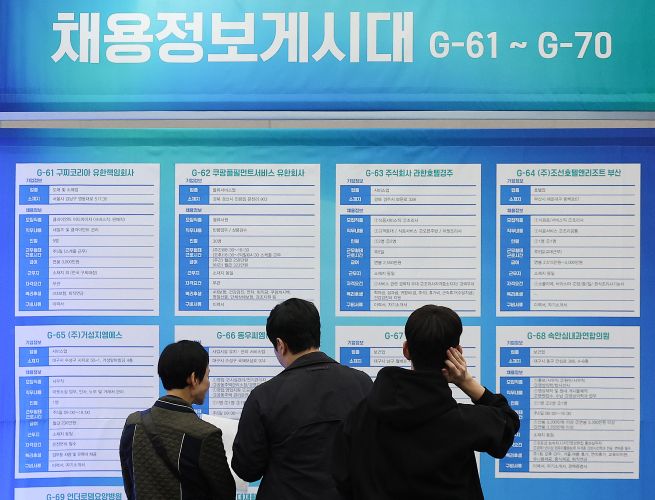
Job seekers review employment information at the “2025 Daegu–Gyeongbuk Job Fair,” held on Nov. 5 at EXCO in Buk-gu, Daegu. (Yonhap)
SEOUL, Nov. 27 (Korea Bizwire) — South Korean young adults are taking significantly longer to land their first full-time job, with those living outside the Seoul metropolitan area facing a growing disadvantage, according to new government research released Thursday.
A study by the Korea Employment Information Service (KEIS) found that the average job-search period for young people has stretched to 22.7 months—four months longer than a decade ago, when the average was 18.7 months. Only about one in ten young adults now find a job immediately upon graduation, down from nearly one in five ten years earlier.
The report, published in the KEIS Employment Trends Brief, compared ten years of longitudinal youth panel data from 2007 and 2021. It found a widening regional gap: young people in the Seoul metropolitan area took an average of 21.2 months to secure their first job, while those in non-metropolitan regions waited 24.6 months—roughly three months longer.
A decade ago, both groups took about 18 months. Since then, job-search times in Seoul have lengthened by two to three months, while delays in regional areas have expanded by more than six months.
The study cited multiple factors behind the prolonged job-hunting process, concluding that “the transition to a first job has become significantly more difficult in recent years.” The share of young people requiring more than four years to find work also rose, from 13.9 percent to 15.9 percent.
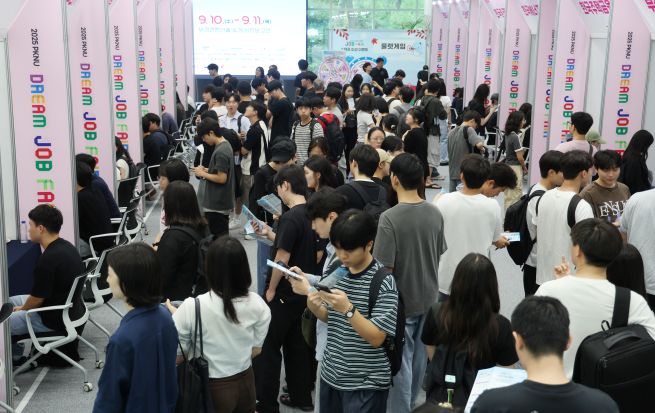
Job seekers consult with company recruiters during the “PKNU Dream Job Fair” held at Pukyong National University in Nam-gu, Busan. (Yonhap)
Gender differences were notable: men took an average of 27.1 months to find their first job, compared with 18.8 months for women—a gap researchers attributed in part to mandatory military service among high school–educated men.
Education level was another major determinant. Four-year college graduates found employment in an average of 10 months, but those with only a high school diploma needed nearly three years. Although job-search times for high school graduates have shortened from 48 months in the past to 33.6 months today, they remain the slowest group to find stable work.
The nature of first jobs has also shifted. The share of new workers entering regular full-time positions fell from 73.3 percent to 61.2 percent, while temporary employment jumped from 24.9 percent to 34.7 percent. Daily-wage positions more than doubled.
Researchers suggested that as job searches drag on, many young people are accepting precarious work simply to gain experience, even when the positions fall short of their expectations.
Ashley Song (ashley@koreabizwire.com)