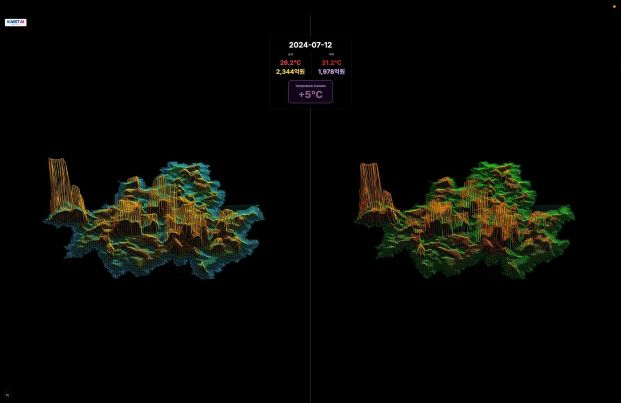
The first project examined the relationship between urban heat and commercial activity. (Image courtesy of KAIST)
DAEJEON, Oct. 30 (Korea Bizwire) — South Korea’s top science institute has unveiled new research that uses artificial intelligence to interpret how climate and urban environments affect city life, as global interest grows in applying data-driven tools to urban policymaking.
KAIST’s Urban AI Lab said Wednesday it presented joint findings with the MIT Senseable City Lab at the Smart Life Week 2025 exhibition in Seoul. The two institutions have been working together on an “Urban AI” program designed to analyze major urban challenges through advanced machine learning models.
The first project examined the relationship between urban heat and commercial activity. Researchers analyzed more than 300 million data points on weather conditions and sales across 96 business types in 426 districts of Seoul.
The study found significant regional disparities: roughly 65 percent of convenience stores operated in “climate-neutral” zones, while the remaining 35 percent were located in “climate-sensitive” areas where heat and humidity exert a measurable impact on sales.
The team also developed a new “Urban Heat Resilience” index to assess how well local business districts can withstand and recover from climate stress, providing policymakers and small merchants with a clearer picture of which areas face greater risk.
A second project, an extension of MIT’s global “Feeling Nature” initiative, integrates street-level imagery, satellite data and resident surveys to measure not only physical factors like tree coverage and park space but also citizens’ perceptions of emotional well-being in their neighborhoods.
The third effort explores accessibility through “data sonification,” converting climate and economic data into sound so that visually impaired individuals can interpret complex urban information.
KAIST said the predictive models were developed in-house and may be adapted for global cities, including Boston and London, as collaborations expand.
“This is a meaningful achievement that allows us to understand urban change from the citizen’s perspective,” said Kim Man-gi, a board member of the Seoul AI Foundation, which supported the project. “We expect these findings to help shape smarter strategies for small businesses and climate-resilient urban policies.”
Kevin Lee (kevinlee@koreabizwire.com)