South Korea Faces Urgent Need to Upgrade Data Infrastructure for Industrial AI (Image supported by ChatGPT)
SEOUL, June 10 (Korea Bizwire) — Despite its wealth of manufacturing data, South Korea lacks the standardization and integration infrastructure necessary to fully leverage industrial artificial intelligence (AI), according to a new report calling for more proactive engagement from both government and industry.
In its latest publication, “AI-Driven Transformation of Korea’s Key Export Industries,” the Korea International Trade Association (KITA) emphasized that while Korea holds a competitive edge in manufacturing data—a critical asset in the industrial AI era—systemic shortcomings in data refinement and interoperability remain major hurdles.
“AI is reshaping industrial operations across the board, and access to high-quality, structured manufacturing data is becoming a decisive factor in competitiveness,” the report stated.
KITA noted that South Korea, as a manufacturing powerhouse, is well-positioned in this global shift. Citing World Bank data, Korea’s manufacturing sector accounted for 24.3% of GDP in 2024, surpassing Japan (19.2%), Germany (18.5%), and the U.S. (10.5%), though slightly behind China (26.2%).
The country also ranked 4th in global manufacturing competitiveness according to the UN Industrial Development Organization, ahead of Taiwan, the U.S., and Japan.
However, the report warned that much of Korea’s manufacturing data remains unstructured and unstandardized, limiting its practical use for AI applications. A separate study by the Korea Institute for Industrial Economics and Trade similarly flagged weak digital collaboration frameworks and inadequate progress in the manufacturing services sector’s digital transformation.
To close the gap, KITA recommended a phased public-private strategy focused on data quality improvement, ecosystem collaboration, and ultimately, the development of “sovereign AI”—AI systems built and operated independently using domestic data and infrastructure.
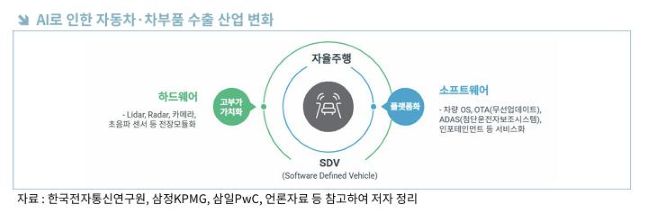
Impact of AI on the Semiconductor Export Industry. (Image courtesy of KITA)
The push for sovereign AI has gained urgency amid intensifying U.S.-China tech competition, with data sovereignty increasingly viewed as essential to national competitiveness and security.
AI’s influence is already transforming Korea’s key export sectors:
-
Semiconductors are shifting toward AI-optimized chips.
-
Automobiles are evolving into software-defined vehicles (SDVs) with autonomous capabilities.
-
Machinery is embracing predictive maintenance and smart manufacturing.
-
Biotech and healthcare are seeing breakthroughs in AI-driven drug development and personalized medical devices.
“AI is fundamentally redrawing the global trade landscape,” said Kang Sung-eun, senior researcher at KITA. “It’s imperative that small and mid-sized enterprises, in particular, integrate industrial AI by leveraging Korea’s rich manufacturing data—and that government and industry work together to achieve sovereign AI.”
Kevin Lee (kevinlee@koreabizwire.com)