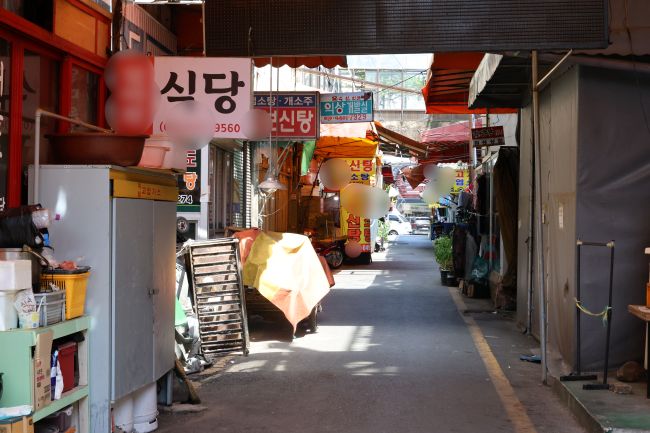
Chilseong Dog Market in Daegu’s Buk-gu district are voicing frustration over what they describe as insufficient government compensation for closing or converting their businesses. (Image courtesy of Yonhap)
DAEGU, July 11 (Korea Bizwire) — As South Korea moves to phase out the dog meat trade, vendors at Chilseong Dog Market in Daegu’s Buk-gu district are voicing frustration over what they describe as insufficient government compensation for closing or converting their businesses.
On July 10, just days before the start of Chobok—a traditional day associated with eating dog meat-based dishes—business at the once-bustling market was nearly at a standstill.
Many storefronts stood empty, their interiors littered with old furniture from long-closed herbal medicine shops and dog meat restaurants. Those still open showed little activity, with workers silently waiting by boiling cauldrons or absent altogether.
“I’m over 70 now, and they’re telling me to start a new career—might as well be telling me to die,” said Mr. Kwon, who has operated a herbal tonic shop at the market for over 50 years.
Under the Dog Meat Consumption Prohibition Act, passed in early 2024, raising, slaughtering, distributing, or selling dogs for consumption will be banned starting February 7, 2027. In preparation, the government has been offering support for vendors who voluntarily shutter or transition their operations. However, shop owners argue the amounts fall far short of what’s needed.
The current support includes ₩400,000 (about $290) for those who close their businesses to cover dismantling and restoration costs, and ₩250,000 (about $180) for those converting to other food businesses, including signage and menu updates.
“That barely covers a signboard,” said one restaurant owner. “How are we supposed to start a whole new business with that?”
Another vendor, Mr. Kim, who runs a dog meat restaurant inherited from his father, said he plans to continue operations even after the law takes effect. “I’ll pay the fines if I have to,” he said. “We need real financial support to make a transition.”
According to local officials, seven vendors have applied to convert their businesses, while four have opted for closure under the program. But there is currently no plan for increased compensation, according to the Ministry of Agriculture, Food and Rural Affairs, which oversees the initiative.
Animal rights advocates have also expressed concern—but for different reasons. Sim In-seop, head of the group Life, criticized the three-year grace period and urged local authorities to accelerate the closure of such markets while also ensuring a stable transition for affected vendors.
As the debate continues, Chilseong Market stands as a symbol of the nation’s struggle to reconcile cultural traditions with evolving views on animal welfare—and the human costs of policy change.
M. H. Lee (mhlee@koreabizwire.com)