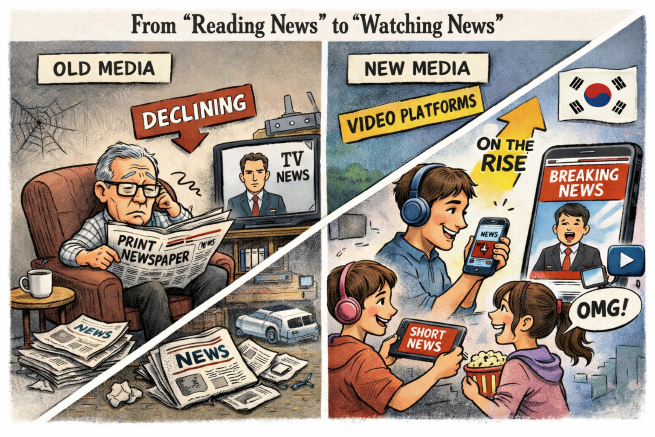
South Koreans Turn From Portals to Video Platforms for News, Survey Finds (Image supported by ChatGPT)
SEOUL, Jan. 5 (Korea Bizwire) — South Koreans are increasingly turning to video platforms rather than internet portals to consume news, signaling a broader shift from text-based journalism to visual formats, according to a new nationwide survey released on Monday.
The findings, published in the Korea Press Foundation’s 2025 Media Audience Survey, show that the share of adults who accessed news through online video platforms jumped sharply to 30 percent in 2025, up from 18.4 percent a year earlier. YouTube overwhelmingly dominated that category, accounting for more than 90 percent of video-based news consumption.
By contrast, the use of internet portals—long the primary gateway to news in South Korea—continued to decline. About 66.5 percent of respondents said they had used portal news in the previous week, down 1.2 percentage points from the year before and the lowest level since the foundation began tracking portal usage in 2017. Portal news consumption peaked at 79.2 percent in 2021 and has fallen steadily since.
The shift reflects a broader transformation in how South Koreans engage with news. Short-form video news usage more than doubled over the past year, rising from 11.1 percent to 22.9 percent. Television news, a traditional medium, also staged a rebound, with weekly usage climbing to 81.4 percent in 2025 from 72.2 percent in 2024, reversing a four-year decline.
Print newspapers, however, continued their long slide. Only 8.4 percent of respondents said they had read at least one print newspaper article, including PDF versions, in the previous week—an all-time low.

Leading progressive-leaning YouTube channels that have drawn large audiences — Kim Eo-jun’s “Humble Is Hard News Factory,” “Maebul Show,” and “OhmyTV” (Image source: screenshots from each channel)
Among people in their 20s and 30s, readership fell to just 3.1 percent and 4.2 percent, respectively. Even older readers, historically the most loyal audience, showed signs of disengagement, with readership among those in their 50s dropping sharply from 15.3 percent to 10.4 percent.
The average time spent reading print newspapers also declined, falling to 28.5 minutes a day, the first decrease in four years.
The survey’s authors noted that overall news consumption rebounded last year amid major political events, including the impeachment of a president and a snap election, but said the growth was driven almost entirely by video-based media. “The transition from ‘reading news’ to ‘watching news’ is clearly accelerating,” the report said.
Use of generative artificial intelligence as a news source remained marginal, at 2.1 percent, though researchers said its influence could grow. Public trust in news and current affairs rose modestly to 49 percent, up 3.5 percentage points from the previous year, though younger respondents expressed lower levels of trust than older ones.
Respondents identified sensational headlines, repetitive click-driven articles and political bias as the most serious problems facing the news media, underscoring persistent concerns about quality and credibility in an increasingly crowded digital news environment.
Lina Jang (linajang@koreabizwire.com)