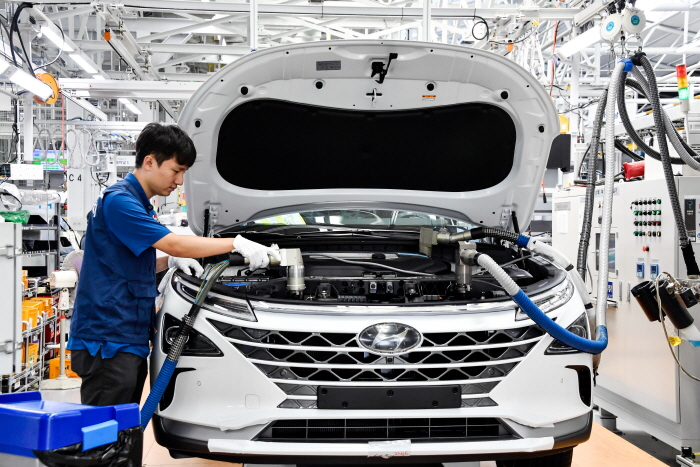
Production line of Hyundai Motor’s hydrogen fuel cell vehicle, NEXO. (Photo courtesy of Hyundai Motor)
SEOUL, Sept. 18 (Korea Bizwire) — Thirty years ago, Hyundai Motor Co. was still shedding its image as a latecomer, eager to catch up with established automakers in the United States, Europe and Japan. Today, South Korea’s largest carmaker is aiming to leap ahead, announcing its most ambitious growth strategy yet: a 77.3 trillion won (US$55.7 billion) investment from 2026 to 2030 to reinvent itself around electric mobility, software-defined vehicles (SDVs) and advanced manufacturing.
The plan, disclosed Thursday in a regulatory filing ahead of Hyundai’s Investor Day in New York, represents a 10 percent increase over last year’s guidance. It underscores the company’s determination to secure its place as a global mobility leader in an era when traditional engine powertrains are giving way to batteries, chips and code.
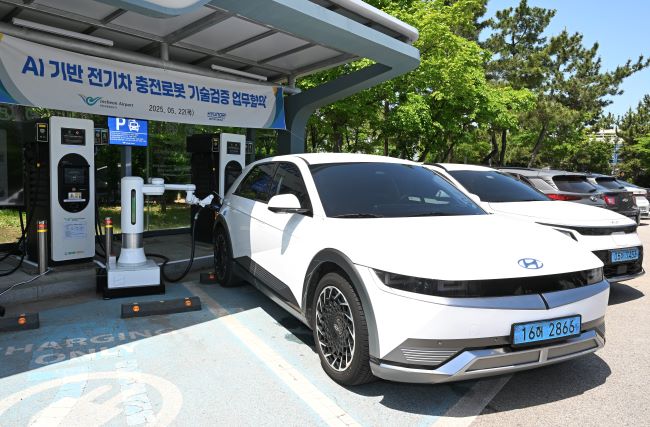
This photo provided by Hyundai Motor Co. shows an automatic charging robot charging an Ioniq 5 EV model at Incheon International Airport, west of Seoul. (Yonhap)
Aiming for Scale — and Balance
Hyundai reaffirmed its goal of selling 5.55 million vehicles worldwide by 2030, with nearly two-thirds electrified. That translates into 3.3 million hybrids, plug-in hybrids and fully electric cars — a target that would fundamentally reshape Hyundai’s product mix. The company also pledged to expand its hybrid lineup to more than 18 models and introduce region-specific EVs such as the Ioniq 3 in Europe, a locally designed model in India and the Elexio SUV in China.
The automaker is equally intent on scaling its production footprint. In Georgia, Hyundai’s Metaplant America is expected to deliver half a million units annually by 2028, while new capacity expansions are planned in India, Korea and Saudi Arabia.
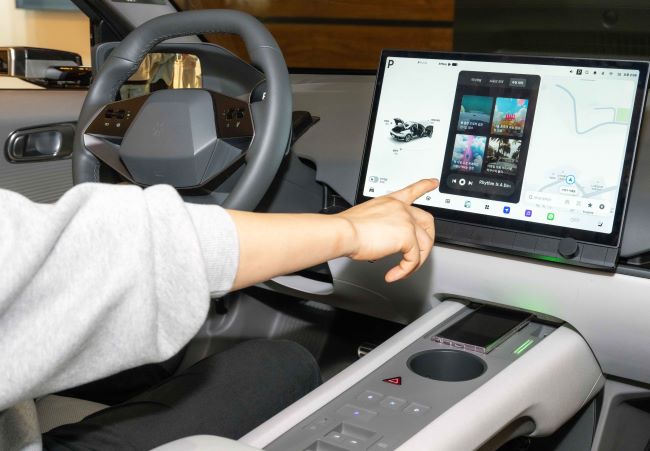
This photo provided by Hyundai Motor Group shows the group’s upcoming infotainment system displayed at the group’s Pleos 25 developer conference held at COEX in Seoul on March 28, 2025. (image courtesy of Hyundai Motor Group)
Betting on Chips and Software
If past decades were about catching up in design and quality, the coming decade is about competing in semiconductors and software. Hyundai said it will channel resources into battery innovation — targeting a 30 percent cost reduction and 15 percent gains in density and charging speed by 2027. Just as crucial is its SDV strategy, anchored by a new electronic and electrical architecture and the Pleos operating system, designed to make cars more upgradable, customizable and connected.
That pivot echoes wider industry trends. Tesla has made software updates routine, and Toyota has pledged similar transitions. Hyundai’s challenge will be to merge its manufacturing heft with Silicon Valley-style adaptability.
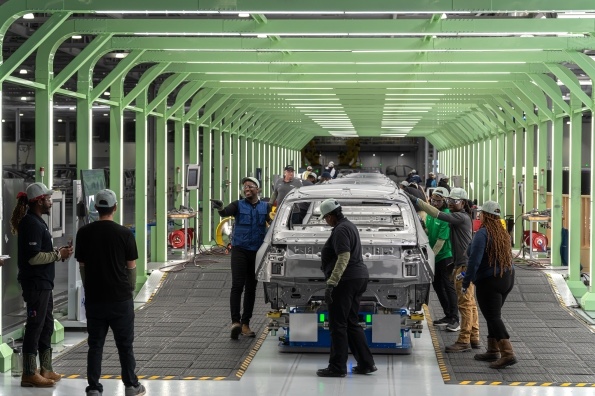
Workers assemble the IONIQ 5 at Hyundai Motor Group Metaplant America (HMGMA) in Georgia, ahead of its official completion ceremony on March 26 (local time). (Image provided by Hyundai Motor)
Expanding Beyond Passenger Cars
Hyundai’s blueprint stretches into commercial vehicles and high-performance lines. The company plans to launch at least seven new N-brand performance cars by 2030 and expand offerings in fuel-cell trucks and large electric vans. For the United States, a mid-size pickup is slated for release before 2030 — a nod to the importance of the North American market.
Investor Returns and Strategic Stakes
The company is also sending a clear signal to investors. From 2025 to 2027, Hyundai pledged to return more than 35 percent of earnings through dividends, share buybacks and stock cancellations, guaranteeing a minimum dividend of 10,000 won per share. By 2027, the automaker aims to secure a sustainable operating margin of 7–8 percent, rising to 8–9 percent by 2030.
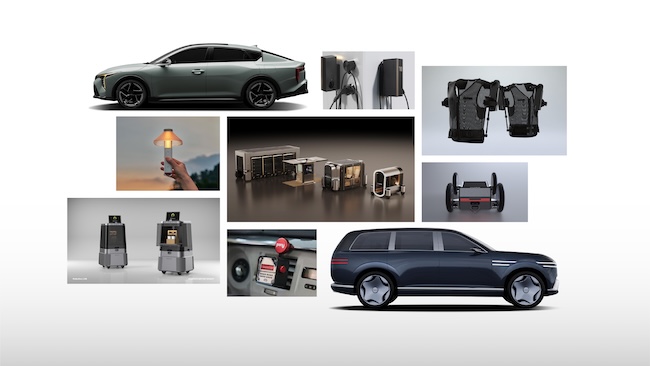
This image provided by Hyundai Motor Group on Jan. 17, 2025, shows products that received accolades at the 2024 Good Design Awards in the United States for their innovative design competitiveness. (Image courtesy of Yonhap)
A Defining Decade
Hyundai’s timing reflects both opportunity and urgency. Global EV adoption is accelerating, but competition is fierce: China’s BYD dominates mass-market EVs, while Tesla remains a benchmark in software integration. Hyundai is betting that its blend of manufacturing efficiency, aggressive R&D and global reach can carve out a leadership role.
In Seoul, the announcement also carries symbolic weight. South Korea has long relied on its auto industry as an export engine; Hyundai’s promise to lead in EVs, software and clean mobility signals a bid not just to keep pace, but to shape the future.
As Investor Day unfolds in New York, Hyundai is presenting itself less as a traditional automaker and more as a technology-driven mobility company. Whether it can deliver on the promise of this $56 billion gamble will likely determine not just its own trajectory, but also South Korea’s standing in the next era of global industry.
Kevin Lee (kevinlee@koreabizwire.com)