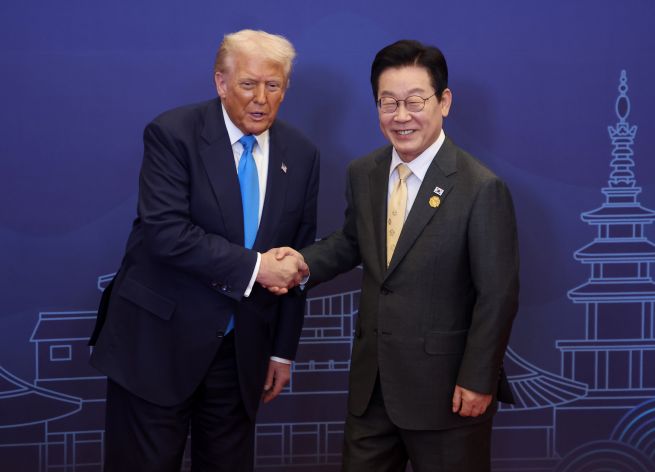
President Lee Jae Myung greets U.S. President Donald Trump ahead of a presidential state dinner held in the Grand Ballroom of the Hilton Hotel in Gyeongju, North Gyeongsang Province, on October 29. (Yonhap)
SEOUL, Oct. 29 (Korea Bizwire) — South Korea’s auto industry breathed a sigh of relief on Wednesday after the United States agreed to lower tariffs on Korean vehicles, a move that removes a major trade irritant and strengthens a deal underpinning Seoul’s $350 billion investment pledge in the American economy.
The announcement followed a summit between President Lee Jae Myung and President Donald Trump in Gyeongju, where the two leaders finalized the remaining details of a tariff and investment arrangement reached in July.
Under the agreement, Washington will reduce its import duty on South Korean automobiles and parts to 15 percent from 25 percent, bringing the rate in line with those applied to Japan and the European Union.
For South Korea, the decision ends months of unease over competitiveness in the American market, where its automakers had faced higher tariffs than their global rivals. The pact also reaffirms the shipbuilding industry’s growing role in Seoul’s economic diplomacy, particularly as a cornerstone of its investment package.
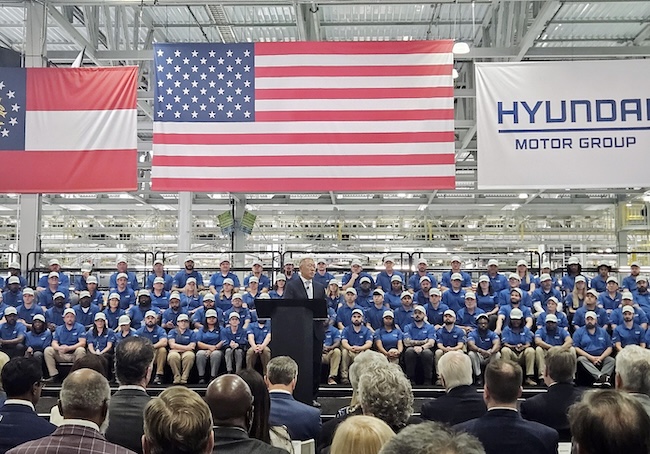
Hyundai Motor Group Executive Chairman Euisun Chung speaks during an opening ceremony of Hyundai Motor Group Metaplant America (HMGMA) in Ellabell, Georgia, on March 26, 2025. (Image courtesy of Yonhap)
According to Kim Yong-beom, the presidential chief of staff for policy, South Korea’s investment commitment will include $200 billion in cash installments and $150 billion dedicated to shipbuilding cooperation, with an annual cap of $20 billion.
The new terms allow Korean companies greater flexibility in how they propose and manage joint projects, a key concession won after weeks of debate over financing and profit sharing.
Hyundai Motor Group welcomed the breakthrough, thanking the government for its “dedicated efforts” and pledging to continue investing in quality, technology and brand competitiveness. The tariff reduction, the company said, would help sustain growth in its largest export market.
Earlier in the day, Trump praised South Korea as a “serious partner” in a keynote address at the APEC CEO Summit, vowing to build a “thriving shipbuilding industry together.”
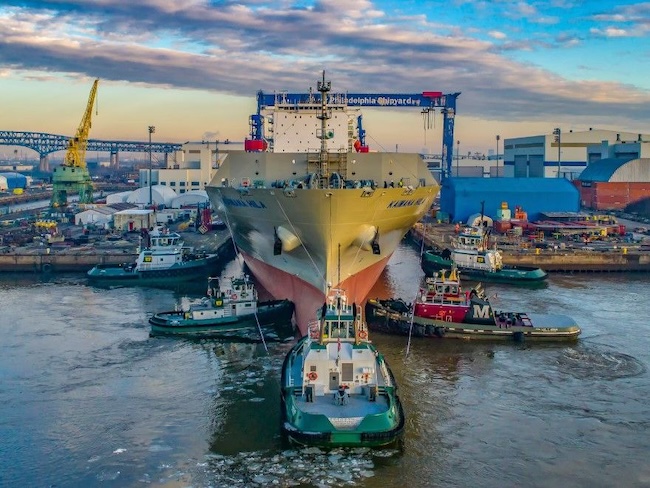
This photo provided by Hanwha Group shows a panoramic view of Philly Shipyard Inc. in Philadelphia, Pennsylvania. (Image courtesy of Yonhap)
The initiative, branded “Make American Shipbuilding Great Again,” has emerged as a signature element of Trump’s industrial strategy and a symbol of Seoul’s willingness to align its economic commitments with Washington’s priorities.
The deal, long delayed by political upheaval in Seoul and drawn-out technical talks, now clears the way for closer coordination between the two allies. For South Korea, it offers both economic relief and an opportunity to strengthen its industrial foothold in the world’s largest market.
Kevin Lee (kevinlee@koreabizwire.com)