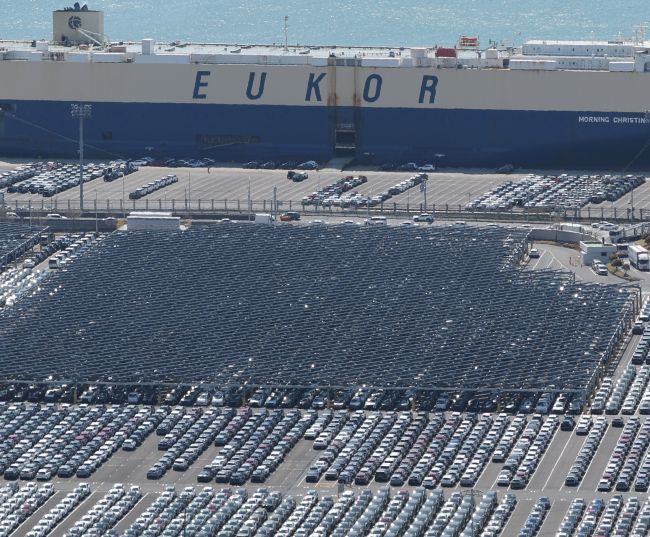
This photo, taken on April 2, 2025, shows completed vehicles awaiting shipment to the United States at Hyundai Motor Co.’s port in Ulsan, 308 kilometers southeast of Seoul. (Image courtesy of Yonhap)
SEOUL, July 2 (Korea Bizwire) — Hyundai Motor Co. and its smaller affiliate Kia Corp. said Wednesday their combined vehicle sales in the United States rose 0.9 percent in June from a year earlier, with growth slowing from the previous month amid ongoing concerns over U.S. auto tariffs.
The two automakers sold a total of 140,374 vehicles in the U.S. last month, slightly up from 139,179 units a year earlier, according to company sales data.
In May, their U.S. sales were up 6.7 percent from a year ago.
Hyundai’s sales rose 4.5 percent on-year to 76,525 units from 73,250, while Kia’s declined 3.2 percent to 63,849 units from 65,929. Hyundai’s figures include sales of its independent luxury brand, Genesis.
The companies said sales were driven by steady demand for gasoline hybrid models, recreational vehicles, and Genesis-brand sport utility vehicles (SUVs) in the world’s largest car market.
In the January-June period, combined U.S. sales climbed 9.2 percent on-year to 893,152 units from 817,804 a year earlier. Hyundai’s sales rose 10.5 percent to 476,641 units from 431,344, while Kia’s grew 7.8 percent to 416,511 from 386,460.
Kia posted a record-breaking first-half sales performance in the U.S. despite lingering uncertainty over sweeping import tariffs imposed by U.S. President Donald Trump.
“Our core models, including the Carnival, Telluride, Sportage and K4, continued to set sales records last month,” Yoon Seung-kyu, president of Kia America, said in a press release.
Looking ahead, however, both companies remain cautious, as they may need to raise vehicle prices later this year to reflect the 25 percent auto tariffs that took effect on April 3.
In addition to the current tariffs, Trump recently warned he may raise auto tariffs further “in the not-too-distant future” to protect American autoworkers.
(Yonhap)