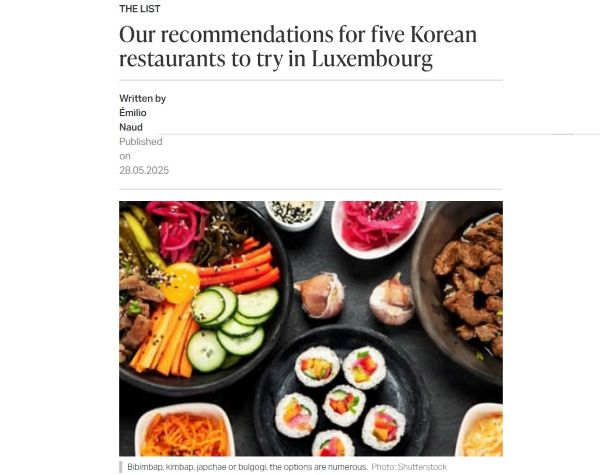
This image, captured from the website of Luxembourg-based Paperjam News, shows an article published May 28, 2025, on Korean food in the European country, as provided by the foreign ministry in Seoul. (Yonhap)
SEOUL, Jan. 18 (Korea Bizwire) – From BTS to “KPop Demon Hunters,” the Korean culture boom has surged across music, screens, dramas, food and social media worldwide, and Luxembourg is riding the wave.
The landlocked Western European country, roughly four times the size of Seoul, is proving no small player in the growing popularity of the Korean Wave.
K-beauty shops selling Korean cosmetics and Korean-style photo booths have appeared on main streets, while interest in Korean cuisine is also heating up, according to the South Korean Embassy in Luxembourg and local media reports.
Several Korean cosmetics shops and photo booths — where customers step inside to take photo strips while donning wigs, hats and novelty glasses — have opened in the city center of the Grand Duchy, flourishing businesses that signal the Korean Wave has taken hold in the country, Luxembourg-based Le Quotidien has reported.
Korean cosmetics have gained huge popularity on the back of the power of social media as videos showcasing Korean beauty routines have gone viral, the news outlet said.
Korean food, in particular, is gaining traction across generations in Luxembourg. In restaurant reviews and dining recommendations, local media have praised Korean cuisine as “distinctive yet well-balanced” and “comforting,” and it is seen not as a passing fad but as settling into the mainstream dining culture.
“Korean restaurants are operating across Luxembourg city and its surrounding areas, with diners already well acquainted with signature dishes, such as Korean-style fried chicken,” the embassy said.
A 2025 online survey on Luxembourg’s perceptions of Korea, commissioned by the embassy, found that nearly 40 percent of respondents cited “K-food” as the first thing that comes to mind when they think of Korea.
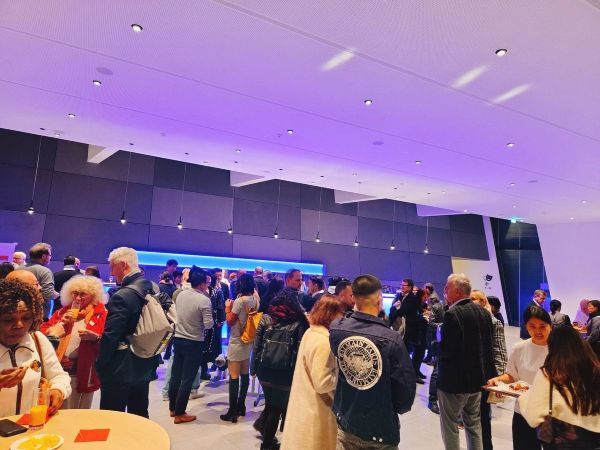
This photo, provided by the foreign ministry, shows a crowd gathered at a Korean film festival at the CELO cultural complex in Hesperange, Luxembourg, on Oct. 30, 2025. (Yonhap)
The interest extends beyond the table. Korean restaurants and local Luxembourgish influencers are hosting hands-on classes on dishes such as gimbap — popular seaweed rice rolls filled with vegetables and meat — reflecting a deepening engagement with Korean food culture.
The depth of local interest was on full display last October, when the embassy-hosted Korean Culture Day event drew some 5,500 people, a notable turnout in a country with a population of 680,000, the embassy said.
“The interest and goodwill toward South Korea, generated by the Korean Wave, are proving to be a real asset in diplomacy as well,” it said.
Luxembourg established diplomatic relations with South Korea in 1962, but the roots of their relationship run deeper. They reach back to the early 1950s, when the small European nation sent around 100 troops to fight alongside U.N.-led forces in support of South Korea during the 1950-53 Korean War.
Measured against its population, the deployment marked the largest troop contribution among the 22 countries that took part in the war.
Building on the historical ties between the two countries, the embassy also plans to focus on veterans-related diplomacy.
With the growing popularity of the Korean culture as a key diplomatic pillar, the embassy is drawing up plans for a wide range of K-food or K-pop events.
“Given Luxembourg’s openness to diverse food cultures, we want to actively promote K-food, including traditional Korean liquors, as premium cultural and lifestyle items,” the embassy said.
“Through these events and activities aimed at introducing Korea, we believe we can expect a ripple effect beyond Luxembourg and into neighboring European countries as well,” it added.
(Yonhap)