

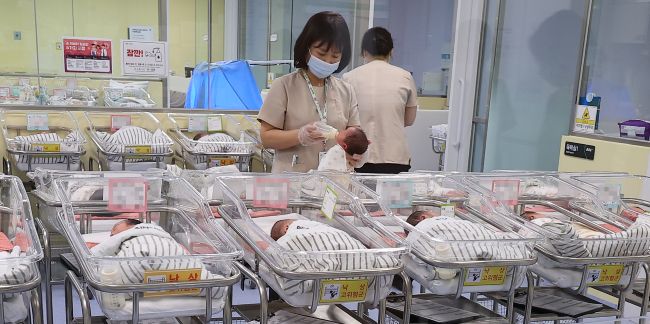
Neonatal medical staff caring for newborns. (Image courtesy of Yonhap)
SEOUL, June 24 (Korea Bizwire) — As South Korea grapples with a persistently low birthrate under President Lee Jae-myung’s administration, a new report highlights how the demographic shift is reshaping the nation’s small business ecosystem, prompting price hikes and deepening inequality among local service providers.
According to a study released Monday by Hana Financial Group’s research institute, businesses catering to infants and young children—such as postpartum care centers, pediatric clinics, and children’s clothing stores—have seen declining demand between 2022 and 2024. To offset losses, many have raised prices, fueling a feedback loop of higher child-rearing costs and declining birth rates.
Postpartum care centers, for instance, experienced an annual average drop of 4% in the number of outlets and a 16.8% decrease in total transaction volume. Yet, the average payment per transaction rose by 23.6%, pushing overall revenue up slightly by 2.9%.
The report warns that this “market contraction–price hike” cycle is exacerbating the cost of parenting, deterring new births and leading to further contraction—a vicious spiral for the sector and broader society.

In South Korea, approximately 85% of new mothers used postpartum care centers last year, spending an average of 2.87 million won for 12.6 days of care (Image courtesy of Yonhap)
Some relief may be on the horizon, with last year’s slight uptick in the national fertility rate offering a possible turning point. But researchers emphasized the urgency of reversing the cycle with coordinated policy support and public-private cooperation.
Meanwhile, other sectors are benefiting from demographic shifts. An aging society and rising demand for professional care services are driving growth in pharmacies, veterinary clinics, psychiatric practices, and elder care facilities.
The report also underscores evolving consumer behavior across age groups. Consumers in their 50s now account for a growing share of spending at cram schools and retraining academies, as delayed parenthood and retirement planning intersect. Their spending at beauty salons and travel agencies has also surged, reflecting increased focus on self-care and leisure.
In contrast, consumption among people in their 20s remains volatile. Businesses such as self-photo studios and coin karaoke rooms have witnessed sharp rises followed by equally steep declines as trends shift.
The report also highlights rising polarization and overconcentration within key small-business sectors. For instance, although the pet supply industry grew by an average of 1.4% annually from 2022 to 2024, the number of outlets rose 4.2%, leading to a 2.7% drop in revenue per store.
Restaurants, another key sector, have become starkly divided. Price-sensitive consumers now gravitate toward either ultra-affordable buffets or premium-tier “it spots” with distinctive offerings—leaving mid-tier establishments increasingly squeezed.
Digital transformation is further reshaping the market, with customer engagement and marketing moving decisively online across real estate, food service, and retail.
“As demand shifts across generations and digital channels, tailored support policies are essential to ensure small businesses can adapt and thrive,” said Kim Moon-tae, a senior researcher at Hana Financial Group.
M. H. Lee (mhlee@koreabizwire.com)




thanks for info.