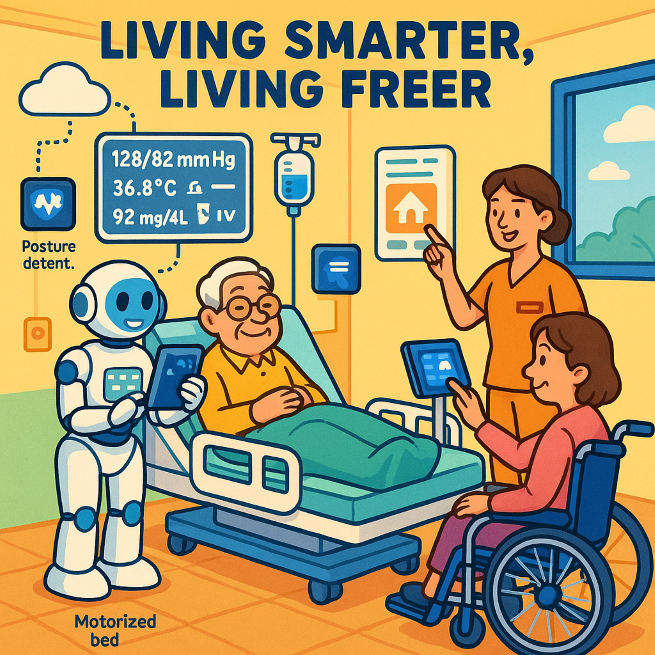
New facility blends cutting-edge sensors and caregiving robots to simulate hospital-grade home care. (Image created by ChatGPT)
SEOUL, May 3 (Korea Bizwire) — South Korea’s National Rehabilitation Center has unveiled its fourth “Smart Care Space,” a high-tech living environment designed to assist elderly individuals and people with disabilities using advanced caregiving robots and sensor-based technologies.
The latest facility, located in the Nuri Building of the National Rehabilitation Center in northern Seoul, spans 19.8 square meters and functions as a demonstration and experiential space.
Visitors—including patients, caregivers, and healthcare professionals—can interact with state-of-the-art assistive technologies under real-life conditions.
Since launching the first Smart Care Space in 2020, the Ministry of Health and Welfare has continued expanding the initiative to support aging populations and individuals with physical impairments.
The fourth iteration includes a range of devices such as a cloud-connected system that automatically collects and stores biometric data—blood pressure, body temperature, blood sugar, and IV drip levels—as well as a nurse-call system and posture-change detection sensors.
![Interior of the Smart Care Space (Image providedd by the Ministry of Health and Welfare]"](http://koreabizwire.com/wp/wp-content/uploads/2025/05/SDD.jpg)
Interior of the Smart Care Space (Image providedd by the Ministry of Health and Welfare]”
The facility also features a motorized bed that can measure body weight, aiming to replicate the environment of a hospital room while enabling in-home care simulation.
In tandem, the center has established a specialized bathing assistance space covering 36.4 square meters. This “Bathing Smart Care Space” includes robotic systems capable of spraying micro-particles for cleansing and a device that enables seamless transfer from wheelchair to bathtub, further enhancing independent living for users with mobility limitations.
Kang Yoon-kyu, Director of the National Rehabilitation Center, emphasized the broader vision behind the initiative.
“The Smart Care Space is actively serving as a hub for real-world trials, user experience, and robotic care technology exhibitions,” he said. “We aim to lead research in this field by working closely with affected individuals, caregivers, and stakeholders.”
The government plans to expand deployment of these smart care systems to hospitals and long-term care facilities nationwide following further trials and evaluations.
Lina Jang (linajang@koreabizwire.com)