
Therma V R290 Monobloc by LG Electronics. (Image courtesy of LG Electronics)
SEOUL, July 16 (Korea Bizwire) — As South Korea seeks to meet its 2035 carbon reduction targets, the government is considering the wide-scale adoption of heat pumps as a key strategy to cut greenhouse gas emissions in the building sector. But the plan has sparked debate over its practicality, cost, and fit with the country’s energy infrastructure and climate conditions.
According to documents obtained by Rep. Park Hong-bae of the Democratic Party, the Ministry of Environment is exploring the inclusion of heat pumps in its forthcoming “2035 Nationally Determined Contribution” (NDC). Environment Minister nominee Kim Sung-hwan, a strong proponent, has highlighted heat pumps alongside renewable energy expansion and electrification as critical tools for decarbonizing buildings.
Heat pumps, devices that transfer heat rather than generate it, can provide heating and cooling with significantly higher energy efficiency than conventional gas boilers. The International Energy Agency estimates they can reduce emissions by at least 20 percent when replacing fossil-fuel-based systems—up to 80 percent in countries powered by clean electricity.
Many countries, including the U.S., Japan, and members of the European Union, have ramped up subsidies and rollout plans for residential and industrial heat pumps in recent years. Japan aims to double installations by 2030, while the EU plans to deploy 10 million units under its REPowerEU plan.
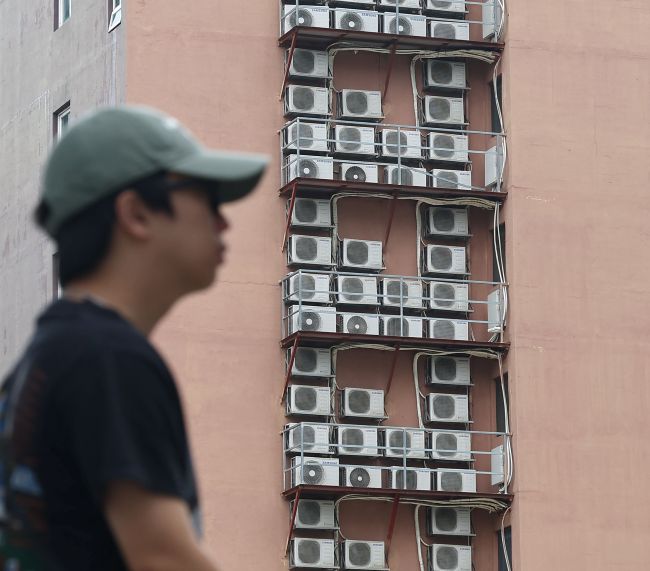
Amid soaring electricity demand driven by scorching heat and tropical nights, air conditioning units are seen operating on a building in Seoul. (Image courtesy of Yonhap)
However, South Korea’s unique building stock and climate pose challenges. With roughly 80 percent of housing in high-rise apartments and temperature swings from −20°C in winter to 40°C in summer, the performance of air-source heat pumps—a common type—can decline in extreme cold.
Cost is another barrier. Installing a heat pump can cost between 11 and 15 million won ($8,000–11,000), about seven times the price of a standard gas boiler. Coupled with South Korea’s tiered electricity pricing, running costs could rise significantly for households.
Critics also point out that most electricity in South Korea is still generated from fossil fuels, undercutting the environmental benefits of electrification. Additionally, refrigerants used in heat pumps often have high global warming potential, and retrofitting existing buildings can be technically challenging due to space constraints.
Industry groups have voiced opposition. Fifteen organizations, including the Korea Mechanical Equipment Construction Association, issued a joint statement in May warning that the heat pump push could harm existing heating and cooling manufacturers while doing little to advance carbon neutrality.
While heat pumps offer potential for emissions cuts, the government faces a delicate balancing act—crafting a viable transition strategy that considers South Korea’s energy mix, consumer costs, and industry dynamics.
M. H. Lee (mhlee@koreabizwire.com)