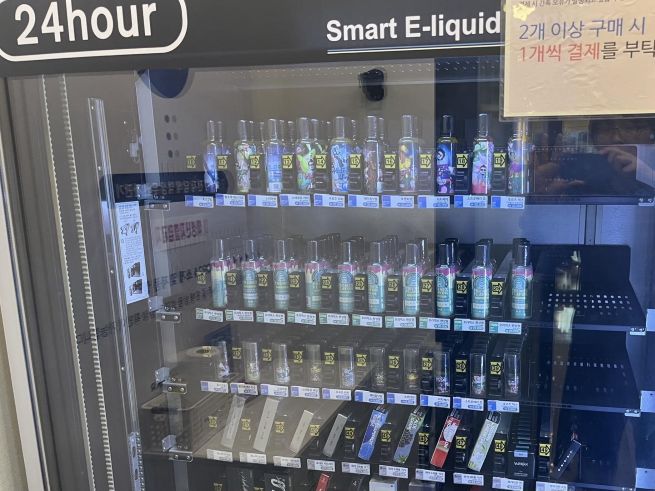
Liquid e-cigarette vending machine (Yonhap)
SEOUL, July 31 (Korea Bizwire) — South Korea’s Minister of Health and Welfare, Chung Eun-kyung, has called for stricter regulation of liquid-based e-cigarettes, equating their health risks to those of traditional combustible cigarettes, especially amid rising use among adolescents.
In a written response submitted to the National Assembly following her confirmation hearing, Chung emphasized that synthetic nicotine-based e-cigarettes should be subject to the same regulatory framework as regular tobacco products, including advertising restrictions, health warnings, and sales oversight.
Currently, South Korea’s Tobacco Business Act defines tobacco as products made wholly or partially from tobacco leaves. This leaves most liquid e-cigarettes—many of which are made from synthetic nicotine—outside the scope of existing regulations, creating what critics call a legal blind spot.
To address this, Minister Chung pledged to support a legislative revision to broaden the legal definition of tobacco from “tobacco leaves” to include “tobacco and nicotine”, thus enabling comprehensive regulation of e-cigarettes.
According to the Ministry, 10 amendment bills to the Tobacco Business Act are currently under review in the National Assembly’s Strategy and Finance Committee.
A recent report from the National Assembly Research Service also backed this move, recommending that nicotine-based products be formally recognized as tobacco and that online sales be banned to help curb youth access.
Data from the Korea Disease Control and Prevention Agency reveals a clear uptick in e-cigarette use among teens. A six-year longitudinal study of students from 6th grade through high school found that e-cigarette usage rose significantly with grade level. Among male students, liquid e-cigarette use increased from 1.19% in 10th grade to 3.57% in 11th, while traditional cigarette use rose from 2.12% to 5.50%.
For female students, usage rates were lower but still rising, with liquid e-cigarette use increasing from 0.94% to 1.54%, surpassing traditional cigarette use for the first time.
The findings have raised alarm among public health officials, who warn that the relative accessibility and flavoring of liquid e-cigarettes are making them especially appealing to younger demographics.
As adolescent vaping becomes more prevalent, policymakers face mounting pressure to close regulatory loopholes and impose uniform restrictions across all nicotine products, regardless of form.
M. H. Lee (mhlee@koreabizwire.com)