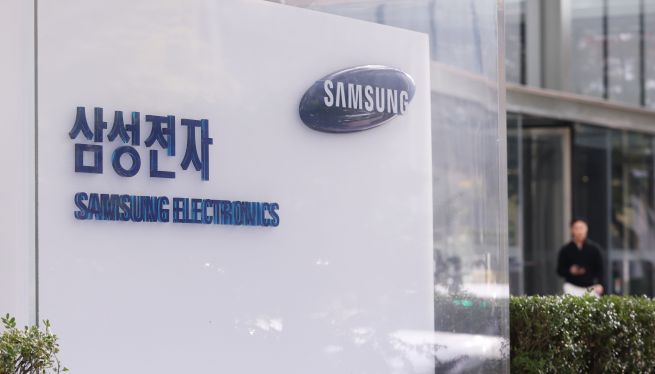
This photo shows Samsung Electronics Co.’s building in southern Seoul. (Yonhap)
SEOUL, Jan. 12 (Korea Bizwire) — Samsung Electronics is on the verge of forming its first-ever majority labor union, as membership in its cross-company union has surged amid persistent employee dissatisfaction over performance-based pay, despite the company’s record profits.
According to industry sources on Jan. 11, membership in the Samsung Electronics branch of the cross-company union climbed to 54,657 as of Jan. 9, up nearly 4,000 in less than two weeks from the end of 2025. At the current pace, the union is expected to surpass the threshold required for majority status as early as this month, or by February at the latest.
A majority union at Samsung Electronics—something unprecedented since the company’s founding—would gain legal status as the sole bargaining representative, with exclusive authority over collective bargaining and labor conditions.
While the exact number required for majority recognition remains subject to verification, union officials estimate it at roughly 62,500 members, based on the pool of eligible employees.
Samsung Electronics, which had 129,524 employees as of mid-2025, including contract workers, has operated under a multi-union system since unions were first established in 2018.
Three unions—Samsung Group United Union Samsung Electronics Company Union (SECU), the National Samsung Electronics Union (NSEU) and Samsung Electronics Union “With you”—are currently engaged in joint wage negotiations with management for 2026. Talks have progressed through four formal rounds, though no major breakthroughs have been reported.

Samsung Electronics Pyeongtaek . (Image courtesy of Samsung Electronics)
The rapid growth of SECU is widely attributed to frustration over the company’s performance-based incentive system, particularly among semiconductor employees.
Roughly 80 percent of the union’s members work in the Device Solutions (DS) division, which oversees semiconductors. As of Jan. 8, DS division membership stood at more than 42,000, with unionization rates in the memory business exceeding 60 percent.
Samsung Electronics posted operating profit of about 20 trillion won ($15 billion) in the fourth quarter of 2025, with an estimated 80 percent generated by the DS division. Yet employees have criticized the calculation of the company’s annual excess profit incentive, known as OPI, calling for greater transparency and the removal of payout caps.
OPI, paid once a year, allows bonuses of up to 50 percent of annual salary when a division exceeds its performance targets, within a cap of 20 percent of excess profit. The payout is currently based on economic value added, or EVA, which deducts capital costs from operating profit—an approach unions argue can understate contributions even during banner years.
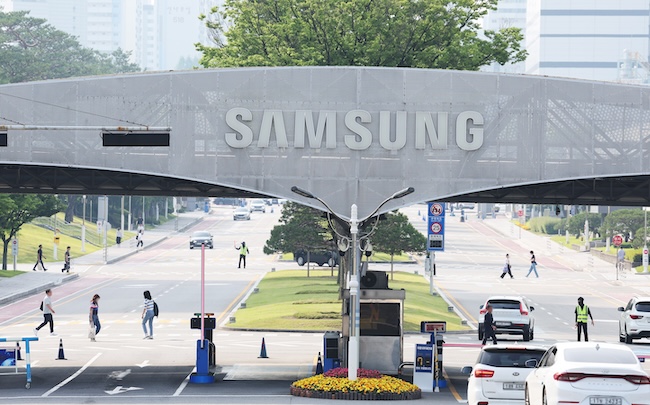
This file photo taken June 7, 2024, shows the main gate of Samsung Electronics Co.’s headquarters in Suwon, south of Seoul. (Image courtesy of Yonhap)
Labor representatives have pointed to rival chipmaker SK hynix, which last year agreed to scrap bonus caps and distribute 10 percent of operating profit as performance pay, as a benchmark for reform.
While Samsung’s DS and mobile divisions are expected to receive relatively high OPI payouts for 2025, other business units are projected to receive significantly lower bonuses, further fueling internal discontent.
Even if SECU secures majority status, analysts say immediate changes may be limited, given that it already participates in negotiations. Still, its ascent marks a symbolic shift in labor relations at South Korea’s largest conglomerate, signaling growing worker assertiveness in an era of record profits and heightened scrutiny of corporate compensation practices.
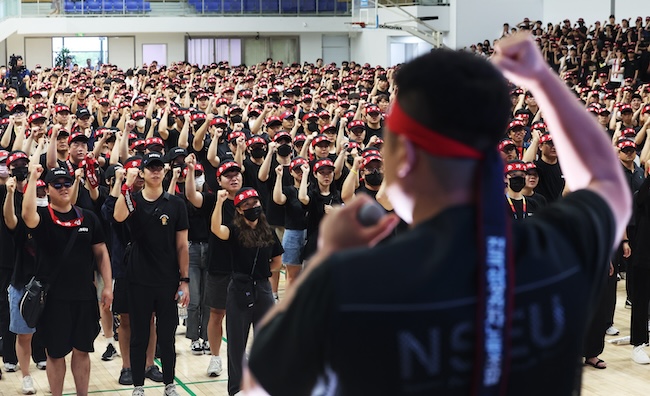
Unionized workers of Samsung Electronics Co. hold a rally at the company’s campus in Yongin, south of Seoul, on July 22, 2024. (Image courtesy of Yonhap)
Kevin Lee (kevinlee@koreabizwire.com)