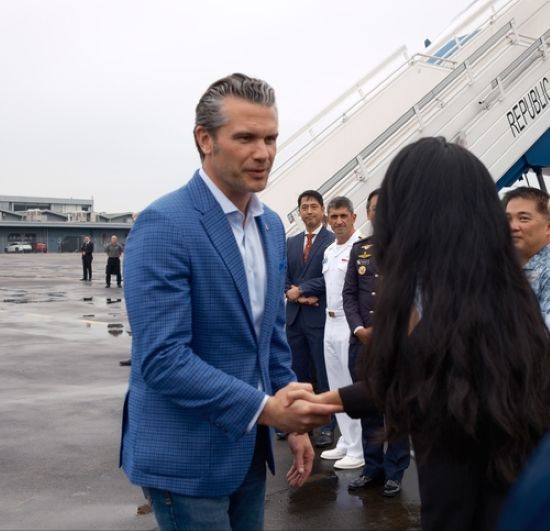
U.S. Defense Secretary Pete Hegseth (L) arrives at an airport in Singapore on May 29, 2025. (Image courtesy Yonhap)
JOINT BASE ANDREWS, Maryland, Oct. 27 (Korea Bizwire) – U.S. Defense Secretary Pete Hegseth began a tour of the Indo-Pacific on Monday, a trip that unfolds like a map of American strategic anxieties: Hawaii, Japan, Malaysia, Vietnam — and finally South Korea.
His message is familiar, but increasingly urgent. The Pentagon says Hegseth intends to press allies to spend more on their own defense and contribute more to the shared burden of regional security.
The subtext is clear. As U.S. competition with China sharpens, Washington wants friends who can carry more of the load.
The trip comes with a rhetorical mantra — “peace through strength” — and a policy framework that casts the Indo-Pacific as the Defense Department’s priority theater. The secretary will, in the Pentagon’s words, underscore the “importance of allies stepping up,” a nod to growing concern that the region’s security architecture has become overly dependent on American deterrence.
His final stop is Seoul, where he will attend the annual Security Consultative Meeting on November 4. There he and South Korean Defense Minister Ahn Gyu-back are expected to discuss the usual docket: North Korea’s expanding nuclear ambitions, the state of the combined defense posture, and extended deterrence.
The Pentagon has already previewed one message: praise for Seoul’s rising military spending and its willingness to assume a larger role within the alliance.
The tour reflects a long-settled principle of U.S. foreign policy — collective defense — that is being reinterpreted for a moment in which militaries are modernizing, autocracies are emboldened, and nuclear anxieties run high.
An attack on one, the idea goes, is an attack on all. Hegseth’s task is to remind allies that the “all” now includes them not just as beneficiaries but as contributors.
In Japan, the secretary will highlight the strengthening of a partnership that has expanded rapidly in scope since China redefined itself as a near-peer threat. In Malaysia, he joins ASEAN defense ministers, where the conversation will inevitably turn to the South China Sea.
In Vietnam, which has been quietly deepening defense ties with Washington, he plans to explore further cooperation on arms and intelligence.
Even the trip’s first stop, Hawaii, frames the moment: meetings with Indo-Pacific Command leaders about readiness, an acknowledgment that American forces are preparing for crises that once felt theoretical.
It is a circuit designed to reassure allies and signal to adversaries. Yet it also reflects a more complicated truth: the United States is asking the region to believe that collective security remains viable in a world where balance is shifting, fast.
M. H. Lee (mhlee@koreabizwire.com)